| |||||||||||||||||||
| |||||||||||||||||||
Larger | Spin | 3D |
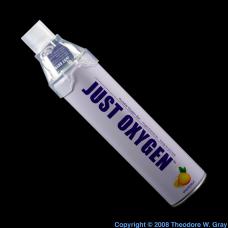
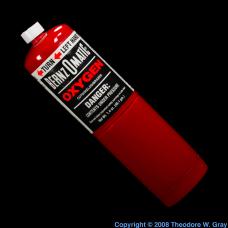
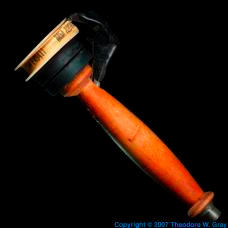
Portable oxygen bar. Oxygen bars were a fad for a while, I think it's kind of over now, but you can still buy cans of concentrated oxygen (they say they are about 80%, compared to the 21% natural concentration in air) meant to be inhaled for non-medical reasons. In a proper oxygen bar you sit around with a tube up your nose trying to look cool and pretend that you don't have a tube up your nose. In this portable version you're meant to inhale deeply while spaying the air (excuse me, the oxygen) towards your face. Breathing air enriched in oxygen is a real treatment for conditions in which either disease (for example smoking-induced lung cancer) prevents the absorption of sufficient oxygen, or conditions (for example reduced peripheral blood flow) make it desirable to increase the amount of oxygen in the blood above its normal level. Whether there is any benefit to breathing extra oxygen if you don't have one of these conditions is less clear. Source: oxygenpartybar Contributor: Theodore Gray Acquired: 8 February, 2009 Text Updated: 8 February, 2009 Price: $15 Size: 8" Purity: 80% |
||||||||||||||||||
Larger |
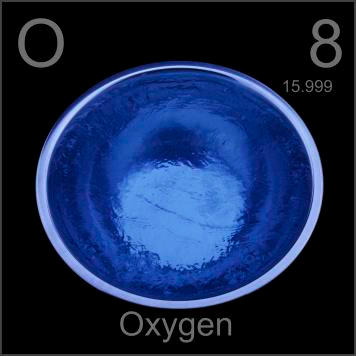
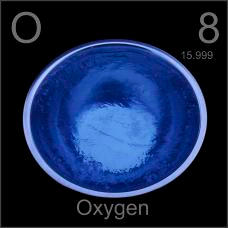
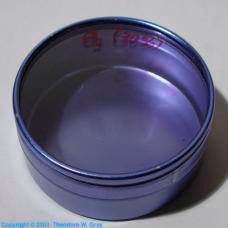
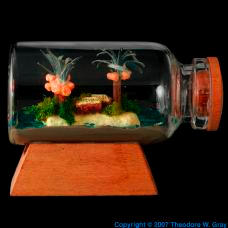
Bowl of liquid oxygen. Liquid oxygen is blue, beautiful sky blue (though the blue of the sky has nothing to do with the fact that oxygen in liquid form is blue). But it's not really quite this blue, except under certain viewing conditions. OK, I feel guilty, I admit it: The blue in this picture is slightly enhanced. But it really does look very blue, even this blue, when you're seeing it for example under a blue sky out of direct sunlight, or under certain kinds of lights, like the metal halide lights in my shop. I wanted to capture that amazing blueness for my periodic table poster, and I admit, I helped it a bit in Photoshop. This is a shameful thing to do, and I'm sorry. (In case you're wondering, the only other samples in my poster that have had any color adjustment applied were gold and copper, which for some reason were just not looking gold or copper colored in print, even though the samples do very much so in person. In those cases, as in the case of oxygen, I tried to make the pictures look like the samples looked to me, even if that meant tweaking the colors compared to what strict application of the measured white balance would require. Color is a tricky thing, and sometimes you have to bend the rules to remove the lies the camera inserts.) This sample to represents its element in my Photographic Periodic Table Poster. The sample photograph includes text exactly as it appears in the poster, which you are encouraged to buy a copy of. 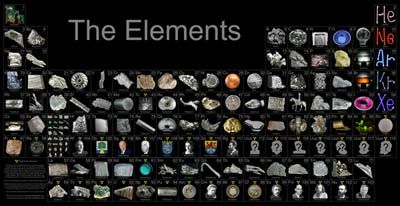 Source: Claudin Welding Supply Contributor: Theodore Gray Acquired: 15 April, 2006 Text Updated: 20 November, 2008 Price: $15 Size: 8" Purity: 99% |
||||||||||||||||||
Larger | Spin | 3D |
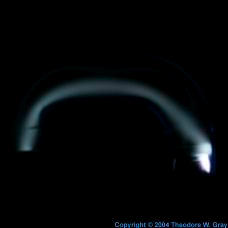
Mounted arc tube. In some ways, gases are a pain from a sample point of view. With the exception of chlorine and bromine they all look exactly the same: Like nothing at all. My beautiful set of noble gas flasks is beautiful because of the flasks, not what's in them, which is indistinguishable from plain air or vacuum. (So much so that I got them for a bargain price because the seller thought the were empty.) But set up an electric current through almost any gas, and things are completely different. The current ionizes the gas, and when the electrons fall back into their orbits, they emit light of very specific frequencies. These spectral lines can easily be seen with even a very cheap pocket spectroscope, and they give the glowing tubes very unusual colors. So unusual in fact that they are basically impossible to photograph. The pictures here simply don't look at all like the real colors of these tubes, which cannot be represented by the limited red, green, and blue mixtures available in computer or printed photographs. David Franco helped arrange these tubes, which were made by a guy who specializes in noble gas tubes and Geissler tubes (click the source link). I have tubes installed in each of the five stable noble gas spots in the table, hooked up underneath to a high voltage transformer. They are really quite beautiful. On my Noble Rack page I have all the pictures collected, along with pictures of arcs I made in my other collection of noble gas flasks. This oxygen tube is not installed in the table, because it's so dim you couldn't really see it, and it's said to not last very long. So I just turned it on long enough to make the photographs (including a 360 degree rotation). Source: Special Effects Neon Contributor: Theodore Gray Acquired: 22 November, 2002 Price: $35 Size: 2.5" Purity: >90% |
||||||||||||||||||
Larger | Spin | 3D |
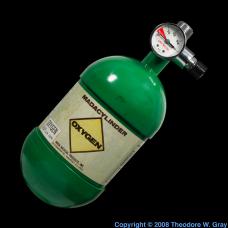
Portable oxygen tank. This is a pair of empty oxygen tanks with regulator, probably intended for people who need supplemental oxygen, or maybe for paramedics to carry around. Source: eBay seller waveles Contributor: Theodore Gray Acquired: 7 November, 2004 Text Updated: 11 March, 2007 Price: $51.50 Size: 12" Purity: >0% Sample Group: Medical |
||||||||||||||||||
Larger |
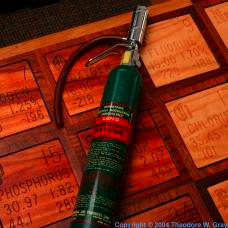
Emergency oxygen tank. I got this tank at the estate auction of a guy who had way too many tools. I'm not sure why he had this tank, but it did come with several hundred pounds of pressure still in it: Next time I'm feeling stressed I'll see if some pure oxygen helps. Source: Auction Contributor: Theodore Gray Acquired: 6 November, 2004 Text Updated: 11 March, 2007 Price: $2 Size: 12" Purity: >90% Sample Group: Medical |
||||||||||||||||||
Larger | Spin | 3D |
Aircraft emergency oxygen system. This unit is designed to supply oxygen for about 5 minutes through a hood you put over your head. It could be a chemical oxygen generator or there could be a small high-pressure tank inside, I'm not sure which and I don't want to open the sealed pouch to find out. Source: eBay seller rustnstuf Contributor: Theodore Gray Acquired: 23 March, 2004 Text Updated: 11 March, 2007 Price: $20 Size: 9" Purity: 90% Sample Group: Medical |
||||||||||||||||||
Larger |
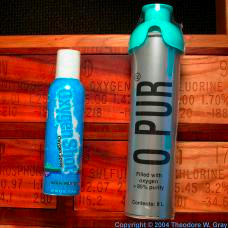
Oxygen spray bottles. I'm sure there's real oxygen in here, I just don't know why. Sure, breathing pure oxygen can be refreshing, if it doesn't make you dizzy, but a lightweight aerosol bottle like this can't contain enough to make any real difference. One of them also contains water which is probably more responsible for the refreshing effect than the oxygen, especially if the bottle is chilled, as they suggest, before you spray it in your face. Source: eBay seller oxygeninc Contributor: Theodore Gray Acquired: 21 March, 2004 Text Updated: 11 March, 2007 Price: $8/3 Size: 8" Purity: 85% Sample Group: Medical |
||||||||||||||||||
Larger |
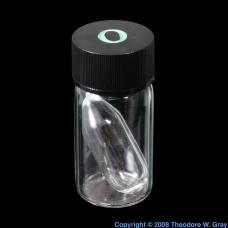
Sample from the Everest Set. Up until the early 1990's a company in Russia sold a periodic table collection with element samples. At some point their American distributor sold off the remaining stock to a man who is now selling them on eBay. The samples (except gases) weigh about 0.25 grams each, and the whole set comes in a very nice wooden box with a printed periodic table in the lid. To learn more about the set you can visit my page about element collecting for a general description and information about how to buy one, or you can see photographs of all the samples from the set displayed on my website in a periodic table layout or with bigger pictures in numerical order. Source: Rob Accurso Contributor: Rob Accurso Acquired: 7 February, 2003 Text Updated: 20 November, 2008 Price: Donated Size: 0.2" Purity: >99% |
||||||||||||||||||
| |||||||||||||||||||
Larger |
Sample from the RGB Set. The Red Green and Blue company in England sells a very nice element collection in several versions. Max Whitby, the director of the company, very kindly donated a complete set to the periodic table table. To learn more about the set you can visit my page about element collecting for a general description or the company's website which includes many photographs and pricing details. I have two photographs of each sample from the set: One taken by me and one from the company. You can see photographs of all the samples displayed in a periodic table format: my pictures or their pictures. Or you can see both side-by-side with bigger pictures in numerical order. The picture on the left was taken by me. Here is the company's version (there is some variation between sets, so the pictures sometimes show different variations of the samples): 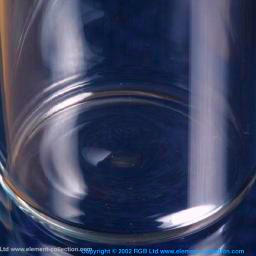 Source: Max Whitby of RGB Contributor: Max Whitby of RGB Acquired: 25 January, 2003 Text Updated: 11 August, 2007 Price: Donated Size: 0.2" Purity: 99.9% |
||||||||||||||||||
Larger | Spin | 3D |
Mini welding gas cylinder. Cylinders like this are sold in any hardware store for use with small welding/brazing torches. They are nothing like the heavy, thick-walled oxygen cylinders used with real welding torches. But they are cheap and do contain actual oxygen. Many people don't realize that when you use an oxyacetylene cutting torch to cut steel plate, the acetylene is just there to get things started. Once the steel is hot enough, you turn off the acetylene and blow pure oxygen at the advancing cut. The oxidation (burning) of iron in pure oxygen releases enough heat to keep the reaction going, and a jet of high pressure oxygen can literally burn through four inch thick solid steel plate. I learned this from Harry Barnhart, a thinking farmer who showed me how it's done one day many years ago. Because the air around us is only about 21% oxygen, steel will burn in air, but it won't generate enough heat to keep the burning going unaided. In air, the steel will cool down and stop burning pretty quickly unless you give it extra heat. This is the principle of the plasma-arc cutting torch (pictured under hafnium), which uses just electricity and air to cut steel. As when you turn off the acetylene in an oxyacetylene torch, the steel itself is the fuel that powers the cutting action, but without pure oxygen to energize things, the plasma-arc cutter has to use an electric arc to supply the necessary extra heat. Another fun thing you can do with oxygen in liquid form is use it to speed up the grilling process. The classic documentation for this was available here, except that it's been removed because of the concerns of the university that had been hosting it. Source: Hardware Store Contributor: Theodore Gray Acquired: 5 August, 2002 Text Updated: 20 November, 2008 Price: $5 Size: 12" Purity: >95% |
||||||||||||||||||
Larger | Sound |
Natural sample, 21% Pure. I collected this sample of naturally occurring air (21% pure oxygen) from about 20 feet away from the table in May, 2002. The sound for this sample is a beautiful 78% nitrogen, 21% oxygen wind sound borrowed from ftp://ftp.zib.de/pub/UserHome/Luegger/Urania/Sound/FX-03.WAV . Source: Air Contributor: Theodore Gray Acquired: 18 May, 2002 Price: $0/Free like the air we breathe Size: 2.5" Purity: 21% |
||||||||||||||||||
Larger | Spin | 3D |
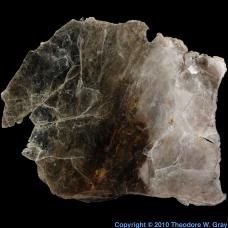
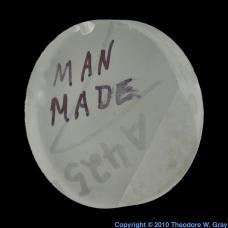
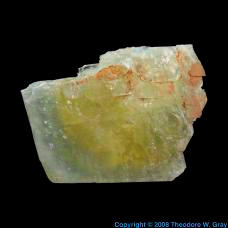
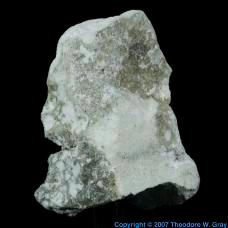
Mica sheet. This is a sheet of mica, a papery thin mineral that was often used as an electrical insulator. The term mica refers to a range of specific minerals and I don't know which one this is exactly, so the composition is just a guess. Source: Mark Peterson Contributor: Mark Peterson Acquired: 13 January, 2010 Text Updated: 13 January, 2010 Price: Donated Size: 3" Composition: (KLi2Al(Al,Si)3O10(F,OH)2 |
||||||||||||||||||
Larger | Spin | 3D |
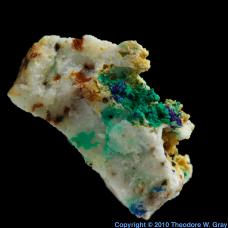
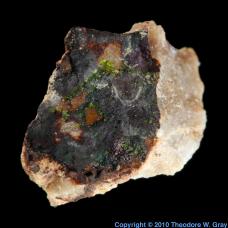
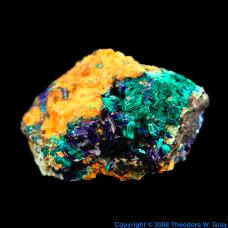
Azurite and Malachite. Azurite and Malachite (Cu+23 (CO3)2 (OH)2 mon. ; Cu+22 (CO3) (OH)2 mon.), Brixlegg, Tyrol, Austria. Nice, from an historic alpine mine. 2,2x1,5x1 cm; 10 g with box. Source: Simone Citon Contributor: John Gray Acquired: 13 January, 2010 Text Updated: 13 January, 2010 Price: Trade Size: 1" Composition: Cu3(CO3)2(OH)2+Cu2(CO3)(OH)2 |
||||||||||||||||||
Larger | Spin | 3D |
Emmonsite. Description from the source: Emmonsite (Fe2+3 Te3+4 O9 x 2 H2 O tric.), Moctezuma, Sonora, Mexico. Green crust on matrix, rare. 1,1x1x0,7 cm; 4 g with box. Source: Simone Citon Contributor: John Gray Acquired: 13 January, 2010 Text Updated: 13 January, 2010 Price: Trade Size: 0.5" Composition: Fe3Te4O9.2(H2O) |
||||||||||||||||||
Larger | Spin | 3D |
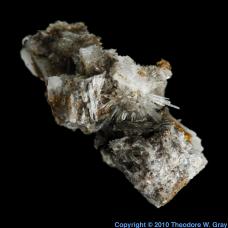
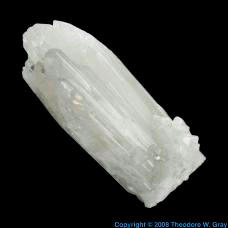
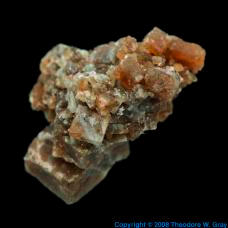
Aragonite. Description from the source: Aragonite (Ca CO3 orth.), Salzburg, Austria. Transparent elongated crystals on matrix. 2,5x1,5x1 cm; 8 g with box. Source: Simone Citon Contributor: John Gray Acquired: 13 January, 2010 Text Updated: 13 January, 2010 Price: Trade Size: 1" Composition: CaCO3 |
||||||||||||||||||
Larger | Spin | 3D |
Quartz slice. An unpolished slice of synthetic quartz. Source: Mark Peterson Contributor: Mark Peterson Acquired: 13 January, 2010 Text Updated: 13 January, 2010 Price: Donated Size: 0.5" Composition: SiO2 |
||||||||||||||||||
Larger | Spin | 3D |
Ekanite. An ekanite crystal. Source: Warut Roonguthai Contributor: Warut Roonguthai Acquired: 13 January, 2010 Text Updated: 13 January, 2010 Price: Donated Size: 0.25" Composition: ThCa2Si8O20 |
||||||||||||||||||
Larger | Spin | 3D |
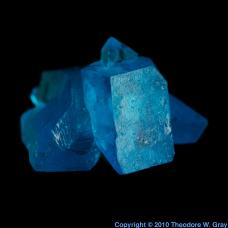
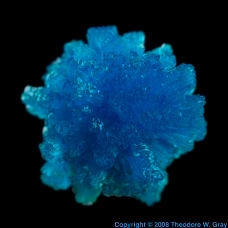
Copper sulfate crystal. An individual crystal of copper sulfate from a bottle of root killer (designed to poured down drains to get rid of roots growing into drain lines). Source: Farm & Fleet Contributor: Theodore Gray Acquired: 13 January, 2010 Text Updated: 13 January, 2010 Price: $0.01 Size: 0.25" Composition: CuSO4 |
||||||||||||||||||
| |||||||||||||||||||
Larger | Spin | 3D |
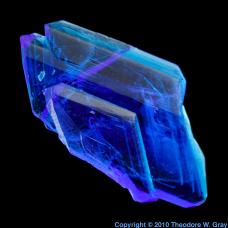
Copper sulfate crystal. An individual crystal of copper sulfate from a bottle of root killer (designed to poured down drains to get rid of roots growing into drain lines). Source: Farm & Fleet Contributor: Theodore Gray Acquired: 13 January, 2010 Text Updated: 13 January, 2010 Price: $0.01 Size: 0.25" Composition: CuSO4 |
||||||||||||||||||
Larger | Spin | 3D |
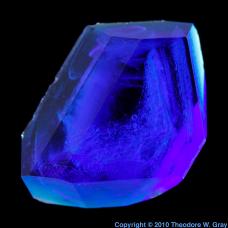
Copper sulfate crystal. An individual crystal of copper sulfate from a bottle of root killer (designed to poured down drains to get rid of roots growing into drain lines). Source: Farm & Fleet Contributor: Theodore Gray Acquired: 13 January, 2010 Text Updated: 13 January, 2010 Price: $0.01 Size: 0.25" Composition: CuSO4 |
||||||||||||||||||
Larger | Spin | 3D |
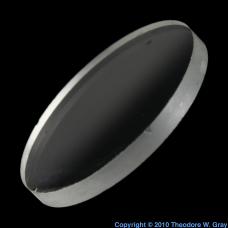
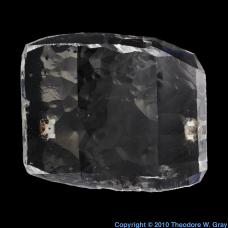
Quartz window. A large lab-grown quartz window. Source: Mark Peterson Contributor: Mark Peterson Acquired: 13 January, 2010 Text Updated: 13 January, 2010 Price: Donated Size: 0.5" Composition: SiO2 |
||||||||||||||||||
Larger | Spin | 3D |
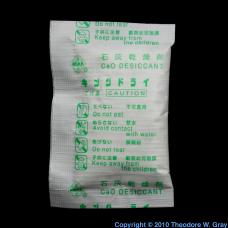
Quicklime Desiccant. This interesting little desiccant packet came in something I got from China. Most desiccant packets (which are packed up with many products to keep them dry during shipping) are made with silica gel, but this one is made with quicklime (calcium oxide, CaO). The difference is that if you pour water on silica gel it doesn't do much of anything, but if you pour water on quicklime, it becomes so hot it boils the water, producing steam and spitting hot water out. Source: Theodore Gray Contributor: Theodore Gray Acquired: 12 January, 2010 Text Updated: 12 January, 2010 Price: Donated Size: 3" Composition: CaO |
||||||||||||||||||
Larger | Spin | 3D |
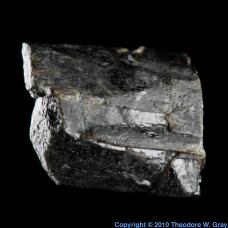
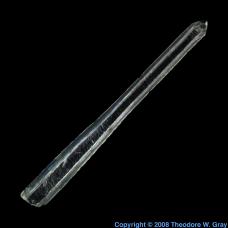
Large Synthetic Quartz. A large lab-grown quartz single crystal, made to be cut up into small bits to be used as quartz crystal oscillators. Source: Mark Peterson Contributor: Mark Peterson Acquired: 12 January, 2010 Text Updated: 13 January, 2010 Price: Donated Size: 4" Composition: SiO2 |
||||||||||||||||||
| |||||||||||||||||||
Larger | Spin | 3D |
Baddeleyite. Sample of Baddeleyite in raw form. Source: eBay seller corockgal Contributor: Theodore Gray Acquired: 12 January, 2010 Text Updated: 12 January, 2010 Price: $15 Size: 0.25" Composition: ZrO2 |
||||||||||||||||||
Larger | Spin | 3D |
Zincite. The mineral Zincite. Source: Jensan Scientifics Contributor: Theodore Gray Acquired: 31 October, 2009 Text Updated: 31 October, 2009 Price: Anonymous Size: 1" Composition: (Zn, Mn, Fe)O |
||||||||||||||||||
Larger | Spin | 3D |
Fergusonite. Description from the source: Fergusonite-Y (Y Nb O4 tet.), Gilderdalen, Iveland, Nordge. Black lustrous masses on matrix. 1,4x1x0,6 cm; 5 g with box. Source: Simone Citon Contributor: John Gray Acquired: 31 October, 2009 Text Updated: 31 October, 2009 Price: Trade Size: 0.5" Composition: YNbO4 |
||||||||||||||||||
Larger | Spin | 3D |
Coltan ore. You may have heard about an effort some years ago to organize a boycott against cell phones. This is the motivation behind the boycott: Coltan. The name is a contraction of columbite and tantalite, which are the major minerals present in the ore. The name columbite comes from the old name of niobium, columbium. Tantalite is of course named for its major component, tantalum. Coltan is a major ore for tantalum, used in capacitors found in nearly all digital electronics, including cell phones (and computers and talking dolls and defibrillators and pretty much everything else invented since 1980). The problem with coltan is that some of it comes from a region in the Congo that is one of last habitats for gorillas. It's also an area home to the other kind of gorilla, guerrillas, who are fighting various nasty wars with each other, and using revenues from coltan mining to pay for those wars. Gorillas are being killed to fund guerrilla wars, and digital electronics are the beneficiaries. The boycott didn't last long, and it's kind of hard to imagine how the sponsors planned to organize it without the use of cell phones. It's also worth noting that less than one percent of the world's supply of tantalum comes from the Congo. Source: Jensan Scientifics Contributor: Theodore Gray Acquired: 16 October, 2009 Text Updated: 18 October, 2009 Price: Anonymous Size: 1" Composition: FeNb2O6+FeTa2O6 |
||||||||||||||||||
Larger | Spin | 3D |
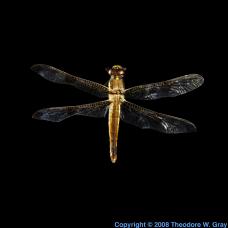
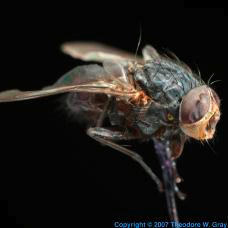
Dragonfly. Another in the line of dead insects supplied by my assistant Nick, behold this magnificent dragonfly. As with the previous fly and cicada killer contributions, all these insects died a natural death: No bugs were harmed in the creation of this website. Source: Nick Mann Contributor: Nick Mann Acquired: 13 June, 2009 Text Updated: 14 June, 2009 Price: Donated Size: 3" Composition: C(H2O) |
||||||||||||||||||
| |||||||||||||||||||
Larger |
Pitchblende. In 1962 it was reported that traces of technetium could be detected in samples of natural pitchblende from Africa. Source: Jensan Scientifics Contributor: Theodore Gray Acquired: 30 April, 2009 Text Updated: 1 May, 2009 Price: Anonymous Size: 1" Composition: UO2+Tc |
||||||||||||||||||
Larger | Spin | 3D |
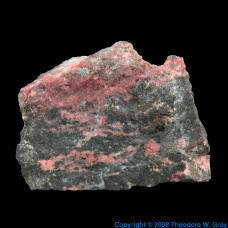
Rhodonite. Rhodonite. Source: Jensan Scientifics Contributor: Theodore Gray Acquired: 25 April, 2009 Text Updated: 27 April, 2009 Price: Anonymous Size: 0.3" Composition: MnSiO3 |
||||||||||||||||||
Larger | Spin | 3D |
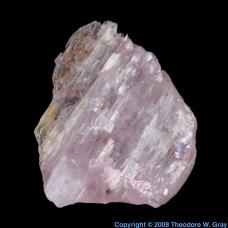
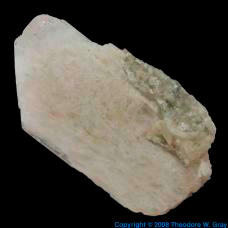
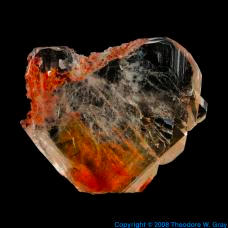
Kunzite. Kunzite. Source: Jensan Scientifics Contributor: Theodore Gray Acquired: 25 April, 2009 Text Updated: 27 April, 2009 Price: Anonymous Size: 0.5" Composition: LiAl[Si2O6] |
||||||||||||||||||
Larger | Spin | 3D |
Kuliokite. Kuliokite rich in lutetium, thulium, and holmium. Source: Jensan Scientifics Contributor: Theodore Gray Acquired: 25 April, 2009 Text Updated: 27 April, 2009 Price: Anonymous Size: 0.1" Composition: (YLuTmHo)4Al(SiO4)2(OH)2F5 |
||||||||||||||||||
Larger | Spin | 3D |
Cassiterite. Cassiterite. Source: Jensan Scientifics Contributor: Theodore Gray Acquired: 25 April, 2009 Text Updated: 27 April, 2009 Price: Anonymous Size: 0.125" Composition: SnO2 |
||||||||||||||||||
| |||||||||||||||||||
Larger | Spin | 3D |
Superconducting powder. YBCO superconducting powder Source: Anonymous Contributor: Theodore Gray Acquired: 2 April, 2009 Text Updated: 17 April, 2009 Price: Anonymous Size: 1" Composition: YBa2Cu3O7 |
||||||||||||||||||
Larger | Spin | 3D |
Fake Emerald. This is a fake (cubic zirconia-based) emerald. Source: Pehnec Gems Contributor: Theodore Gray Acquired: 2 April, 2009 Text Updated: 3 April, 2009 Price: $1 Size: 0.39" Composition: ZrO2 |
||||||||||||||||||
Larger | Spin | 3D |
Baddeleyite. Sample of Baddeleyite in cut gem form. Source: eBay seller freakingcat_gems Contributor: Theodore Gray Acquired: 2 April, 2009 Text Updated: 3 April, 2009 Price: $30 Size: 0.25" Composition: ZrO2 |
||||||||||||||||||
Larger | Spin | 3D |
Zincite. Sample of Zincite. Source: Jensan Scientifics Contributor: Theodore Gray Acquired: 2 April, 2009 Text Updated: 3 April, 2009 Price: Anonymous Size: 1" Composition: (ZnMnFe)O |
||||||||||||||||||
Larger | Spin | 3D |
Wolframite. Sample of Wolframite. Source: Jensan Scientifics Contributor: Theodore Gray Acquired: 2 April, 2009 Text Updated: 3 April, 2009 Price: Anonymous Size: 1" Composition: FeWO4.MnWO4 |
||||||||||||||||||
| |||||||||||||||||||
Larger | Spin | 3D |
Titanite. Sample of Titanite. Source: Jensan Scientifics Contributor: Theodore Gray Acquired: 2 April, 2009 Text Updated: 3 April, 2009 Price: Anonymous Size: 1" Composition: CaTi[O+SiO4] |
||||||||||||||||||
Larger | Spin | 3D |
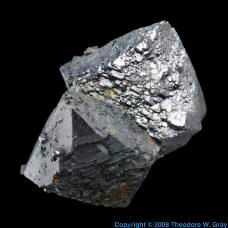
Sphalerite With Siderite. Sample of Sphalerite With Siderite. Source: eBay seller minclassixx Contributor: Theodore Gray Acquired: 2 April, 2009 Text Updated: 3 April, 2009 Price: $34 Size: 10" Composition: (Zn,Fe)(S,Ge) + FeCO3 |
||||||||||||||||||
Larger | Spin | 3D |
Euxenite. Sample of Euxenite. Source: eBay seller sellingoffoddstuff Contributor: Theodore Gray Acquired: 2 April, 2009 Text Updated: 3 April, 2009 Price: $6.50 Size: 1.5" Composition: (Y,Ca,Ce,U,Th)(Nb,Ta,Ti)2O6 |
||||||||||||||||||
Larger | Spin | 3D |
Columbite. Sample of Columbite, one of the components of coltan ore. Source: Jensan Scientifics Contributor: Theodore Gray Acquired: 2 April, 2009 Text Updated: 17 October, 2009 Price: Anonymous Size: 0.5" Composition: FeNb2O6 |
||||||||||||||||||
Larger | Spin | 3D |
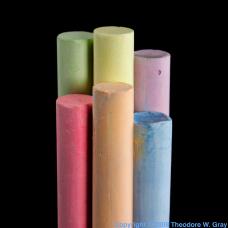
Colored Chalk. Simple writing chalk, which is made of gypsum, not the rock also known as chalk. Source: Hobby Lobby Contributor: Theodore Gray Acquired: 2 April, 2009 Text Updated: 3 April, 2009 Price: $2 Size: 4" Composition: CaSO4 |
||||||||||||||||||
| |||||||||||||||||||
Larger | Spin | 3D |
Bismuth Germanate crystal. Bismuth germanate crystals like this one are used in scintillation detectors. Source: eBay seller mc17cyclotron Contributor: Theodore Gray Acquired: 2 April, 2009 Text Updated: 3 April, 2009 Price: $40 Size: 1.5" Composition: Bi4Ge3O12 |
||||||||||||||||||
Larger | Spin | 3D |
Barium sulfate suspension. EZEM Barium Sulfate Suspension. Source: eBay seller hcas-granite Contributor: Theodore Gray Acquired: 2 April, 2009 Text Updated: 3 April, 2009 Price: $3 Size: 2" Composition: BaSO4+H2O |
||||||||||||||||||
Larger | Spin | 3D |
Large barite crystals. Barite from Gilgit, NWFP, Pakistan. Source: eBay seller saltwonders Contributor: Theodore Gray Acquired: 2 April, 2009 Text Updated: 3 April, 2009 Price: $38 Size: 4" Composition: BaSO4 |
||||||||||||||||||
Larger | Spin | 3D |
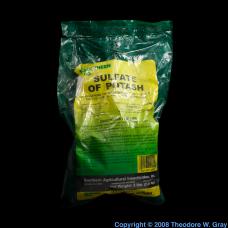
Sulfate Of Potash. An example of a basic potassium fertilizer, potassium sulfate. Source: eBay seller sunshinehope Contributor: Theodore Gray Acquired: 28 March, 2009 Text Updated: 29 March, 2009 Price: $12 Size: 10" Composition: K2SO4 |
||||||||||||||||||
Larger | Spin | 3D |
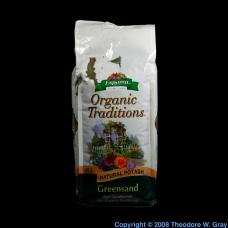
Potash fertilizer. An example of a basic potassium fertilizer, this is 6% K2O, or about 5% potassium. Source: eBay seller sunshinehope Contributor: Theodore Gray Acquired: 28 March, 2009 Text Updated: 29 March, 2009 Price: $12 Size: 10" Composition: K2O |
||||||||||||||||||
| |||||||||||||||||||
Larger | Spin | 3D |
Ilmenite. Sample of Ilmenite. Source: Jensan Scientifics Contributor: Theodore Gray Acquired: 28 March, 2009 Text Updated: 29 March, 2009 Price: Anonymous Size: 0.125" Composition: FeTiO3 |
||||||||||||||||||
Larger | Spin | 3D |
Zircon sand. Jack Hills Zircon Sand. Source: Jensan Scientifics Contributor: Theodore Gray Acquired: 24 March, 2009 Text Updated: 25 March, 2009 Price: Anonymous Size: 0.5" Composition: ZrO2 |
||||||||||||||||||
Larger | Spin | 3D |
Yanomamite. Micromount of a few 0.15mm balls of bluish white Yanomamite associated with Topaz and Cassiterite from the Periquito Mine, Goias, Brazil. Source: eBay seller merlyn8804 Contributor: Theodore Gray Acquired: 24 March, 2009 Text Updated: 25 March, 2009 Price: $60 Size: 0.2" Composition: InAsO4.2H2O |
||||||||||||||||||
Larger | Spin | 3D |
Xenotime. Sample of xenotime. Source: Jensan Scientifics Contributor: Theodore Gray Acquired: 24 March, 2009 Text Updated: 25 March, 2009 Price: Anonymous Size: 0.125" Composition: (YbY)PO4 |
||||||||||||||||||
Larger | Spin | 3D |
Turquoise. Sample of turquoise. Source: Jensan Scientifics Contributor: Theodore Gray Acquired: 24 March, 2009 Text Updated: 25 March, 2009 Price: Anonymous Size: 2" Composition: Cu(Al,Fe)6[(OH)4(PO4)2]2.4H2O |
||||||||||||||||||
| |||||||||||||||||||
Larger | Spin | 3D |
Painite. Sample of painite (Ca Zr B Al9 O18 hex.), Mogok, Myanmar (Burma). Extremely rare crystals. 0,6x0,3x0,2 cm the bigger; 1 g all;. Source: Simone Citon Contributor: John Gray Acquired: 24 March, 2009 Text Updated: 25 March, 2009 Price: Trade Size: 0.25" Composition: CaZrBAl9O18 |
||||||||||||||||||
Larger | Spin | 3D |
Kolbeckite. Sample of kolbeckite. Source: eBay seller d-h-garske Contributor: Theodore Gray Acquired: 24 March, 2009 Text Updated: 25 March, 2009 Price: $50 Size: 2" Composition: ScPO4.2H2O |
||||||||||||||||||
Larger | Spin | 3D |
Goethit. Sample of goethit. Source: Jensan Scientifics Contributor: Theodore Gray Acquired: 24 March, 2009 Text Updated: 25 March, 2009 Price: Anonymous Size: 0.5" Composition: FeO(OH) |
||||||||||||||||||
Larger | Spin | 3D |
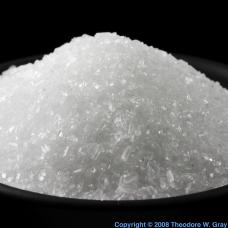
Epsom Salt. Epsom salt, magnesium sulfate, is used for soaking feet and various other industrial applications. Source: Walmart Contributor: Theodore Gray Acquired: 24 March, 2009 Text Updated: 8 April, 2009 Price: $3 Size: 2" Composition: MgSO4 |
||||||||||||||||||
Larger | Spin | 3D |
Dioptas. Sample of dioptas. Source: Jensan Scientifics Contributor: Theodore Gray Acquired: 24 March, 2009 Text Updated: 25 March, 2009 Price: Anonymous Size: 2" Composition: Cu6(Si6O18).6H2O |
||||||||||||||||||
| |||||||||||||||||||
Larger | Spin | 3D |
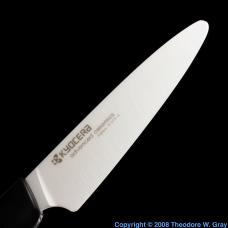
Zirconium oxide ceramic knife. Knives like this are incredibly sharp, but tend to chip after a while. Source: Mall Contributor: Theodore Gray Acquired: 24 March, 2009 Text Updated: 25 March, 2009 Price: $30 Size: 6" Composition: ZrO2 |
||||||||||||||||||
Larger | Spin | 3D |
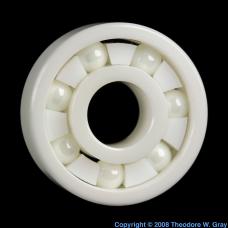
Zirconium oxide street luge bearing. This is a solid zirconium oxide ceramic ball bearing meant for street luge, whatever that is. See similar silicon nitride ball bearing. Source: eBay seller irvineman Contributor: Theodore Gray Acquired: 24 March, 2009 Text Updated: 25 March, 2009 Price: $30 Size: 0.75" Composition: ZrO2 |
||||||||||||||||||
Larger | Spin | 3D |
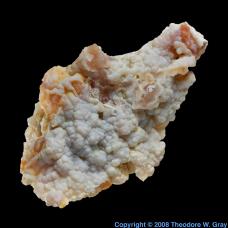
BotryoidalAgate. BotryoidalAgate. Source: Jensan Scientifics Contributor: Theodore Gray Acquired: 24 March, 2009 Text Updated: 24 March, 2009 Price: Anonymous Size: 2" Composition: SiO2 |
||||||||||||||||||
Larger | Spin | 3D |
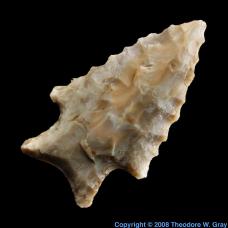
Arrowhead. I'm guessing this arrowhead is flint, a form of quartz, but that's just a guess. Source: Nick Mann Contributor: Nick Mann Acquired: 24 March, 2009 Text Updated: 24 March, 2009 Price: Donated Size: 1.5" Composition: SiO2 |
||||||||||||||||||
Larger | Spin | 3D |
Siderite. Description from the source: Siderite (Fe+2 CO3 trig.), Bad Ems, Germany. Cleavaged masses, typic. 3,6x2x2 cm the bigger; 36 g. Source: Simone Citon Contributor: John Gray Acquired: 11 March, 2009 Text Updated: 12 March, 2009 Price: Trade Size: 1.4" Composition: FeCO3 |
||||||||||||||||||
| |||||||||||||||||||
Larger | Spin | 3D |
Metatorbernite. Description from the source: Metatorbernite ( Cu+2 (UO2)2 (PO4)2x8H2O tet.), Monte Painter, Australia. Green laminar crystals on limonitic, rich in oxides matrix. 6,5x5x3 cm; 87 g. Source: Simone Citon Contributor: John Gray Acquired: 11 March, 2009 Text Updated: 12 March, 2009 Price: Trade Size: 2.5" Composition: Cu(UO2)2(PO4)2.8H2O |
||||||||||||||||||
Larger | Spin | 3D |
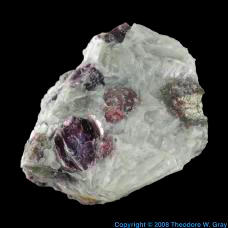
Miserite. Description from the source: Miserite (K (Ca Ce)6 Si8 O22 (OH F)2 tric.), Kipawa Alcalyne Complex, Villedieu Tow., Quebec, Canada. Purple section crystals with granular red Eudyalite and beige Vlasovite. Rich in rare earth elements. 2x1,5x1,5 cm; 6 g. Source: Simone Citon Contributor: John Gray Acquired: 11 March, 2009 Text Updated: 3 April, 2009 Price: Trade Size: 0.75" Composition: K(Ca,Ce)6Si8O22(OH,F)2 |
||||||||||||||||||
Larger | Spin | 3D |
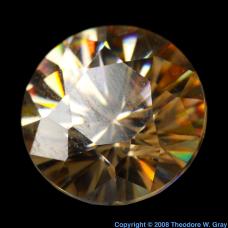
Strontium Titanate fake diamond. Before the widespread use of cubic zirconia as fake diamond, strontium titanate was more popular. It is, however, much softer than diamond, and much more expensive that cubic zirconia. I like it because it's a pretty use of strontium. Source: Theodore Gray Contributor: Theodore Gray Acquired: 11 March, 2009 Text Updated: 12 March, 2009 Price: $20 Size: 0.25" Composition: SrTiO3 |
||||||||||||||||||
Larger | Spin | 3D |
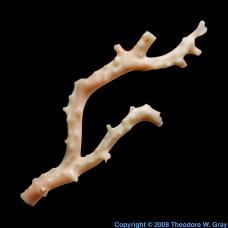
Coral. Very beautiful and rare Hawaiian coral, traded for a poster and some nickel and copper nodules. This is the information that came with it: Hawaiian Precious 'Pink Beauty' Coral Source: John Posey Contributor: Theodore Gray Acquired: 11 March, 2009 Text Updated: 12 March, 2009 Price: Trade Size: 4" Composition: CaCO3 |
||||||||||||||||||
Larger | Spin | 3D |
Betafite. A rare uranium mineral. Source: merlyn8804 Contributor: Theodore Gray Acquired: 11 March, 2009 Text Updated: 12 March, 2009 Price: $20 Size: 1" Composition: (Ca,U)2(Ti,Nb)2O6(OH) |
||||||||||||||||||
| |||||||||||||||||||
Larger | Spin | 3D |
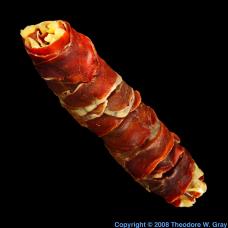
Bacon Lance. No comment. Yet. Source: Theodore Gray Contributor: Theodore Gray Acquired: 11 March, 2009 Text Updated: 12 March, 2009 Price: $10 Size: 6" Composition: CHONaCl |
||||||||||||||||||
Larger | Spin | 3D |
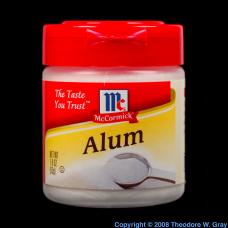
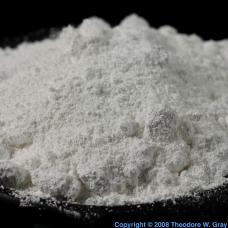
Cooking alum. Powdered alum meant for use in cooking. Source: Walmart Contributor: Nick Mann Acquired: 11 March, 2009 Text Updated: 12 March, 2009 Price: $1 Size: 2" Composition: KAl(SO4)2.12H2O |
||||||||||||||||||
Larger | Spin | 3D |
Titanium dioxide powder. Titanium dioxide is the white in white paint and the opaque in most other paints. Chances are if you look up from your screen, you'll be looking at a wall covered in titanium dioxide. It is cheap and common, unlike titanium metal, which is expensive and not seen nearly as often. This is because turning titanium dioxide (which is one of the main ores of titanium) into its metal form is difficult and expensive, as is working the metal once you have refined it. Source: eBay seller arkie-annie Contributor: Theodore Gray Acquired: 28 February, 2009 Text Updated: 1 March, 2009 Price: $40 Size: 2" Composition: TiO2 |
||||||||||||||||||
Larger | Spin | 3D |
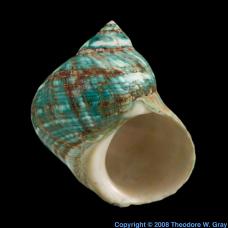
Pretty seashell. This pretty example of calcium carbonate was made by some kind of seashell making sea creature and washed up on a beach in Florida, I think. Source: Florida Contributor: Theodore Gray Acquired: 28 February, 2009 Text Updated: 1 March, 2009 Price: Donated Size: 2" Composition: CaCO3 |
||||||||||||||||||
Larger | Spin | 3D |
Holey limestone. This is "holey limestone" from Texas. Not to be confused with "holy rock". Source: eBay seller endo80 Contributor: Theodore Gray Acquired: 8 February, 2009 Text Updated: 8 February, 2009 Price: $16 Size: 8" Composition: CaCO3 |
||||||||||||||||||
| |||||||||||||||||||
Larger | Spin | 3D |
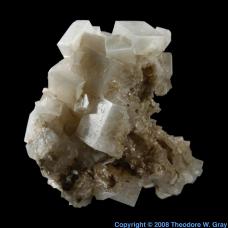
Halite and Borax mixed crystal. This is an attractive crystal of halite (basically salt) and borax (sodium borate) from the Rhodes salt marsh in Nevada. Source: eBay seller ilickrocks Contributor: Theodore Gray Acquired: 8 February, 2009 Text Updated: 8 February, 2009 Price: $5 Size: 1.5" Composition: NaCl + Na2B4O7\[CenterDot]10H2O |
||||||||||||||||||
Larger | Spin | 3D |
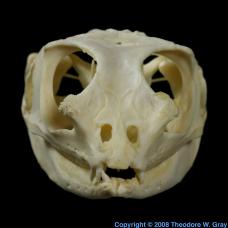
Frilled dragon skull. I've always wanted to buy something from The Bone Room and I finally settled on this pretty Frilled Dragon skull. It's some kind of lizard, and very complex inside, look at the 3D rotation video to see all the internal structures. Source: The Bone Room Contributor: Theodore Gray Acquired: 8 February, 2009 Text Updated: 8 February, 2009 Price: $70 Size: 2" Composition: Ca10(PO4)6(OH)2 |
||||||||||||||||||
Larger | Spin | 3D |
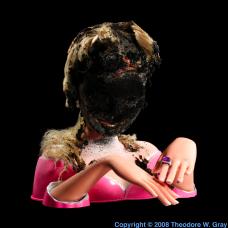
Burned Barbie doll (no glasses). This Barbie (TM) brand doll head was very foolish. She, like her sister featured in the previous sample, had a bad day playing with fireworks. But unlike her sister, she failed to ware safety glasses and as a result will now spend the rest of her life blind in both eyes. Everyone learn from foolish Barbie: WEAR SAFETY GLASSES when working with dangerous chemicals, especially if there is a team making a safety video in the area. Source: Walmart Contributor: Theodore Gray Acquired: 8 February, 2009 Text Updated: 8 February, 2009 Price: $40 Size: 12" Composition: CHO |
||||||||||||||||||
Larger | Spin | 3D |
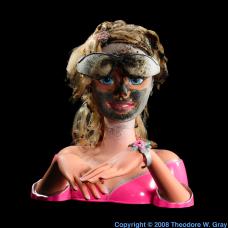
Burned Barbie doll (with glasses). This Barbie (TM) brand doll head is meant for kids to practice hair dressing on: It's about 3/4 life size. Unfortunately this Barbie decided to play with fireworks and had a bad day. Fortunately, she was wearing her safety glasses, and while she may spend some time in the hospital, she's going to be fine, her eyes intact and undamaged. You don't have to imagine what her fate would have been if she'd failed to ware safety glasses, just check out the next sample. Source: Walmart Contributor: Theodore Gray Acquired: 8 February, 2009 Text Updated: 8 February, 2009 Price: $40 Size: 12" Composition: CHO |
||||||||||||||||||
Larger | Spin | 3D |
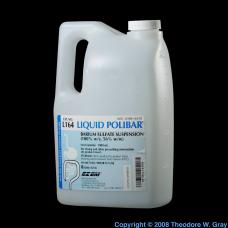
Jug of Polibar barium sulfate. This is an empty jug of Liquid Polibar brand barium sulfate for medical imaging purposes. Basically it's opaque to x-rays, so if you put it into some part of the body, say the intestine, you can tell the exact shape it takes on with a simple x-ray. Filling the intestine is done from both ends, and I'm not sure which end this solution is meant to go in. Hopefully the doctor knows. Source: Dr Chung Contributor: Dr Chung Acquired: 8 February, 2009 Text Updated: 8 February, 2009 Price: Donated Size: 10" Composition: BaSO4 |
||||||||||||||||||
| |||||||||||||||||||
Larger | Spin | 3D |
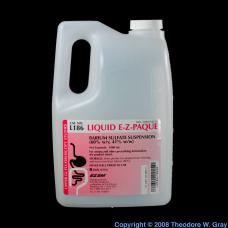
Jug of E-Z-Paque barium sulfate. This is an empty jug of Liquid E-Z-Paque brand barium sulfate for medical imaging purposes. Basically it's opaque to x-rays, so if you put it into some part of the body, say the intestine, you can tell the exact shape it takes on with a simple x-ray. Filling the intestine is done from both ends, and I'm not sure which end this solution is meant to go in. Hopefully the doctor knows. Source: Dr Chung Contributor: Dr Chung Acquired: 8 February, 2009 Text Updated: 8 February, 2009 Price: Donated Size: 10" Composition: BaSO4 |
||||||||||||||||||
Larger | Spin | 3D |
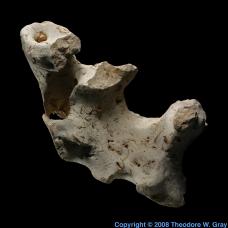
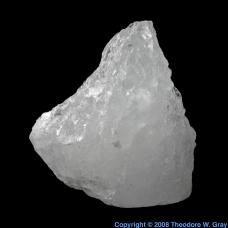
Rock of alum. This is a hunk of potassium alum, used for many things but sold retail in this form primarily as a deodorant. Source: eBay seller saratthasamuccaya Contributor: Theodore Gray Acquired: 8 February, 2009 Text Updated: 8 February, 2009 Price: $6/pound Size: 3" Composition: KAl(SO4)2.12H2O |
||||||||||||||||||
Larger | Spin | 3D |
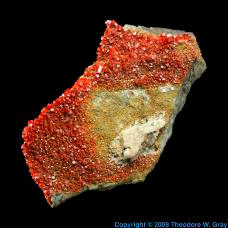
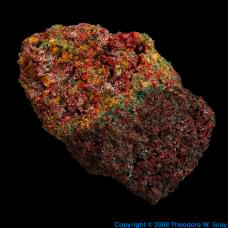
Vanadinite. Description from the source: Vanadinite (Pb5 (VO4)3Cl hex.), Apache Mine, Arizona, USA. Little but evident reddish crystals on solid matrix. 7,5x4x2 cm; 43 g. Source: Simone Citon Contributor: John Gray Acquired: 28 January, 2009 Text Updated: 29 January, 2009 Price: Trade Size: 3" Composition: Pb5(VO4)3Cl |
||||||||||||||||||
Larger | Spin | 3D |
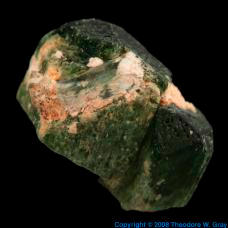
Uvarovite. Description from the source: Uvarovite (Ca3 Cr2 (Si O4)3 cub.), Outokumpu, Finland. Rich association of chrome silicates (Uvarovite, Cr-diopside, Cr-tremolite). 6,5x6,5x2 cm; 136 g. Source: Simone Citon Contributor: John Gray Acquired: 28 January, 2009 Text Updated: 29 January, 2009 Price: Trade Size: 2.6" Composition: Ca3Cr2(SiO4)3 |
||||||||||||||||||
Larger | Spin | 3D |
Topaz. Description from the source: Topaz (Al2 Si O4 (F OH)2 orth.), Perfect, transparent crystals with a bit of matrix. 2,6x2,1x1,5 cm; 10 g with box. Source: Simone Citon Contributor: John Gray Acquired: 28 January, 2009 Text Updated: 29 January, 2009 Price: Trade Size: 1" Composition: Al2SiO4(FOH)2 |
||||||||||||||||||
| |||||||||||||||||||
Larger | Spin | 3D |
Smithsonite. Description from the source: Smithsonite (Zn CO3 trig.), Laurion, Grecia. Light green botryoidal, from old Cu Pb Zn deposit. 6,5x6x2 cm; 48 g. Source: Simone Citon Contributor: John Gray Acquired: 28 January, 2009 Text Updated: 29 January, 2009 Price: Trade Size: 2.6" Composition: ZnCO3 |
||||||||||||||||||
Larger | Spin | 3D |
Pyromorphite. Description from the source: Pyromorphite (Pb5 (PO4)3 Cl hex.), Daoping Mine, China. Little, but very nice crystal group. 1x1x0,8 cm; 2 g. Source: Simone Citon Contributor: John Gray Acquired: 28 January, 2009 Text Updated: 29 January, 2009 Price: Trade Size: 0.4" Composition: Pb5(PO4)3Cl |
||||||||||||||||||
Larger | Spin | 3D |
Pyromorphite. Description from the source: Pyromorphite (Pb5 (PO4)3 Cl hex.), Bad Ems, Germany. Little but evident crystal cluster. 0,8x0,5x0,4 cm; 9 g with box. Source: Simone Citon Contributor: John Gray Acquired: 28 January, 2009 Text Updated: 29 January, 2009 Price: Trade Size: 0.3" Composition: Pb5(PO4)3Cl |
||||||||||||||||||
Larger | Spin | 3D |
Monazite. Description from the source: Monazite ( (Ce La Nd Th) P O4 mon.), Steli near Tveit, Iveland, Nordge. Extremely well crystallized example. 0,8x0,4x0,4 cm; 5 g with box. Source: Simone Citon Contributor: John Gray Acquired: 28 January, 2009 Text Updated: 29 January, 2009 Price: Trade Size: 0.3" Composition: (CeLaNdTh)PO4 |
||||||||||||||||||
Larger | Spin | 3D |
Manganite. Description from the source: Manganite (Mn+3 O (OH) mon.), Ilfeld, Harz, Germany. Isolated, terminated black crystals. 1,3x0,6x0,5 cm the bigger; 3 g all. Source: Simone Citon Contributor: John Gray Acquired: 28 January, 2009 Text Updated: 29 January, 2009 Price: Trade Size: 0.5" Composition: MnO(OH) |
||||||||||||||||||
| |||||||||||||||||||
Larger | Spin | 3D |
Gehlenite. Description from the source: Gehlenite ( Ca2 Al (Al Si) O7 tet.), Le Selle, Monzoni, Trento, Italy. Small but evident. 1,5x1x1 cm; 3 g with box. Source: Simone Citon Contributor: John Gray Acquired: 28 January, 2009 Text Updated: 29 January, 2009 Price: Trade Size: 0.6" Composition: Ca2Al(AlSi)O7 |
||||||||||||||||||
Larger | Spin | 3D |
Elbaite. Description from the source: Elbaite (Na (Li Al)3 Al6 (BO3)3 Si6 O18 (OH)4 trig.), Minas Gerais, Brazil. Isolated, terminated crystal with rare pink-orange color. 2,3x0,8x0,8 cm; 4 g. Source: Simone Citon Contributor: John Gray Acquired: 28 January, 2009 Text Updated: 29 January, 2009 Price: Trade Size: 1" Composition: Na(LiAl)3Al6(BO3)3Si6O18(OH)4 |
||||||||||||||||||
Larger | Spin | 3D |
Danburite. Description from the source: Danburite (Ca B2 (SiO4)2 orth.), Charcas, San Luis Potosi`, Mexico. Prismatic, geminated, partially translucent, good. 6,5x2x1,5 cm; 25 g. Source: Simone Citon Contributor: John Gray Acquired: 28 January, 2009 Text Updated: 29 January, 2009 Price: Trade Size: 2.6" Composition: CaB2(SiO4)2 |
||||||||||||||||||
Larger | Spin | 3D |
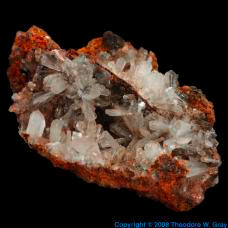
Crocoite And Cr-Cerussite. Description from the source: Crocoite and Cr-cerussite (Pb Cr O4 mon. ; Pb CO3 with Cr orth.), Dundas, Tasmania, Australia. Small, distinct orange Crocoite crystals with yellowish Cromecerussite on matrix, very rich in Cr this example! 6,5x2,5x1,5 cm; 20 g. Source: Simone Citon Contributor: John Gray Acquired: 28 January, 2009 Text Updated: 29 January, 2009 Price: Trade Size: 2.6" Composition: PbCrO4 +PbCO3(Cr) |
||||||||||||||||||
Larger | Spin | 3D |
Cerussite. Description from the source: Cerussite (Pb CO3 orth.), Laurion, Grecia. White acicular crystals on vugs. 3,5x2,5x2 cm; 20 g with box. Source: Simone Citon Contributor: John Gray Acquired: 28 January, 2009 Text Updated: 29 January, 2009 Price: Trade Size: 1.4" Composition: PbCO3 |
||||||||||||||||||
| |||||||||||||||||||
Larger | Spin | 3D |
Cavansite. Description from the source: Cavansite (Ca (V+4 O) Si4 O10x4 H2O orth.), Wagholi Quarry, Jalgaon, Maharashtra, India. 0,8x0,8x0,8 cm each; 8 g with box the two. Source: Simone Citon Contributor: John Gray Acquired: 28 January, 2009 Text Updated: 29 January, 2009 Price: Trade Size: 0.3" Composition: Ca(VO)Si4O10.4(H2O) |
||||||||||||||||||
Larger | Spin | 3D |
Brookite. Description from the source: Brookite (Ti O2 orth.), Magnet Cove, Arkansas, USA. Perfect, geminated black crystals. 1,5x1,2x1 cm; 10 g with box. Source: Simone Citon Contributor: John Gray Acquired: 28 January, 2009 Text Updated: 29 January, 2009 Price: Trade Size: 0.6" Composition: TiO2 |
||||||||||||||||||
Larger | Spin | 3D |
Baryte from Jensan set. This sample represents barium in the "The Grand Tour of the Periodic Table" mineral collection from Jensan Scientifics. Visit my page about element collecting for a general description, or see photographs of all the samples from the set in a periodic table layout or with bigger pictures in numerical order. Source: Jensan Scientifics Contributor: Theodore Gray Acquired: 28 January, 2009 Text Updated: 29 January, 2009 Price: Anonymous Size: 1.5" Composition: BaSO4 |
||||||||||||||||||
Larger | Spin | 3D |
Cassiterite from Jensan set. This sample represents tin in the "The Grand Tour of the Periodic Table" mineral collection from Jensan Scientifics. Visit my page about element collecting for a general description, or see photographs of all the samples from the set in a periodic table layout or with bigger pictures in numerical order. Source: Jensan Scientifics Contributor: Theodore Gray Acquired: 28 January, 2009 Text Updated: 29 January, 2009 Price: Anonymous Size: 1" Composition: SnO2 |
||||||||||||||||||
Larger | Spin | 3D |
Bixbyite. Description from the source: Bixbyite ((Mn+3 Fe+3)2 O3 cub.), Thomas Range, Utah, USA. Perfect crystal. 0,9x0,8x0,8 cm; 9 g with box. Source: Simone Citon Contributor: John Gray Acquired: 10 January, 2009 Text Updated: 10 January, 2009 Price: Trade Size: 0.35" Composition: (Mn,Fe)2O3 |
||||||||||||||||||
| |||||||||||||||||||
Larger | Spin | 3D |
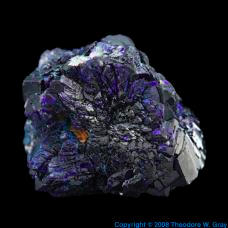
Lepidolite. Description from the source: Lepidolite (K (Li Al)3 (Si Al)4 O10 (F OH)2 mon.), Aracuai`, Minas Gerais, Brazil. Little crystals on clear Quartz. 1,2x0,8x0,8 cm: 1 g. Source: Simone Citon Contributor: John Gray Acquired: 10 January, 2009 Text Updated: 10 January, 2009 Price: Trade Size: 0.5" Composition: K(Li,Al)3(Si,Al)4O10(F,OH)2 |
||||||||||||||||||
Larger | Spin | 3D |
Hematite. Description from the source: Hematite ps. Magnetite (Fe2 O3 trig.), Payun Matri, Volcano, Mendosa, Argentina. Micro laminar crystals after Magnetite. 3x2,5x2,5 cm; 15 g. Source: Simone Citon Contributor: John Gray Acquired: 10 January, 2009 Text Updated: 10 January, 2009 Price: Trade Size: 1.2" Composition: Fe2O3 |
||||||||||||||||||
Larger | Spin | 3D |
Gypsum. Description from the source: Gypsum (Ca SO4x2 H2O mon.), desert of Morocco. Geminate crystals with sand inclusions. 3x2,7x1,2 cm; 6 g. Source: Simone Citon Contributor: John Gray Acquired: 10 January, 2009 Text Updated: 10 January, 2009 Price: Trade Size: 1.2" Composition: CaSO4.2H2O |
||||||||||||||||||
Larger | Spin | 3D |
Dolomite. Description from the source: Dolomite (Ca Mg (CO3)2 trig.), Ramsbeck, Germany. Rombohedral crystal aggregates. 3x2,5x1 cm; 11 g with box. Source: Simone Citon Contributor: John Gray Acquired: 10 January, 2009 Text Updated: 10 January, 2009 Price: Trade Size: 1.2" Composition: CaMg(CO3)2 |
||||||||||||||||||
Larger | Spin | 3D |
Cerussite. Description from the source: Cerussite (Pb CO3 orth.), S. Lauret Le Minieur, France. Translucent crystals on matrix. 2,5x2x1,5 cm; 10 g with box. Source: Simone Citon Contributor: John Gray Acquired: 10 January, 2009 Text Updated: 10 January, 2009 Price: Trade Size: 1" Composition: PbCO3 |
||||||||||||||||||
| |||||||||||||||||||
Larger | Spin | 3D |
Cerussite. Description from the source: Cerussite (Pb CO3 orth.), Tsumeb, Namibia. Nice transparent crystal cluster. 3x2,5x1,5 cm; 15 g. Source: Simone Citon Contributor: John Gray Acquired: 10 January, 2009 Text Updated: 10 January, 2009 Price: Trade Size: 1.2" Composition: PbCO3 |
||||||||||||||||||
Larger | Spin | 3D |
Cassiterite. Description from the source: Cassiterite (Sn O2 tet.), Viloco Mine, La Paz, Bolivia. Good quality crystals. 2,5x2x1 cm; 12 g. Source: Simone Citon Contributor: John Gray Acquired: 10 January, 2009 Text Updated: 10 January, 2009 Price: Trade Size: 1" Composition: SnO2 |
||||||||||||||||||
Larger | Spin | 3D |
Ankerite. Description from the source: Ankerite (Ca (Fe+2 Mg Mn) (CO3)2 trig.), Laubuseschbach, Taunus, Germany. Brown crystal cluster on the same matrix. 3x2x1,8 cm; 15 g. Source: Simone Citon Contributor: John Gray Acquired: 10 January, 2009 Text Updated: 10 January, 2009 Price: Trade Size: 1.2" Composition: Ca(FeMgMn)(CO3)2 |
||||||||||||||||||
Larger | Spin | 3D |
Allophane. Description from the source: Allophane (amorphous hydrous aluminum silicate), Steyermark, Tyrol, Austria. An amorphous mineral on very delicate matrix. 3x1,8x1 cm; 3 g. Source: Simone Citon Contributor: John Gray Acquired: 10 January, 2009 Text Updated: 10 January, 2009 Price: Trade Size: 1.2" Composition: (Al2O3)(SiO2)1.3-2+2.5-3H2O |
||||||||||||||||||
Larger | Spin | 3D |
Allanite-Y. Description from the source: Allanite-Y, Arendal, Nordge. Black, lustrous, massive. 3x1,5x1 cm; 10 g. Source: Simone Citon Contributor: John Gray Acquired: 10 January, 2009 Text Updated: 10 January, 2009 Price: Trade Size: 1.2" Composition: (CaY)(Al2Fe)(O,OH,SiO4,Si2O7) |
||||||||||||||||||
| |||||||||||||||||||
Larger | Spin | 3D |
Tantalite from Jensan Set. This sample represents tantalum in the "The Grand Tour of the Periodic Table" mineral collection from Jensan Scientifics. Visit my page about element collecting for a general description, or see photographs of all the samples from the set in a periodic table layout or with bigger pictures in numerical order. Source: Jensan Scientifics Contributor: Theodore Gray Acquired: 10 January, 2009 Text Updated: 10 January, 2009 Price: Anonymous Size: 0.6" Composition: (Mg,Fe)(Ta,Nb)2O6 |
||||||||||||||||||
Larger | Spin | 3D |
Hafnon from Jensan Set. This sample represents hafnium in the "The Grand Tour of the Periodic Table" mineral collection from Jensan Scientifics. Visit my page about element collecting for a general description, or see photographs of all the samples from the set in a periodic table layout or with bigger pictures in numerical order. Source: Jensan Scientifics Contributor: Theodore Gray Acquired: 10 January, 2009 Text Updated: 10 January, 2009 Price: Anonymous Size: 0.3" Composition: (Hf,Zr)[SiO4] |
||||||||||||||||||
Larger | Spin | 3D |
Euxenite from Jensan Set. This sample represents lutetium in the "The Grand Tour of the Periodic Table" mineral collection from Jensan Scientifics. Visit my page about element collecting for a general description, or see photographs of all the samples from the set in a periodic table layout or with bigger pictures in numerical order. Source: Jensan Scientifics Contributor: Theodore Gray Acquired: 10 January, 2009 Text Updated: 10 January, 2009 Price: Anonymous Size: 0.6" Composition: (Y,Ca,Ce,Lu,U,Th)(Nb,Ta,Ti)2O6 |
||||||||||||||||||
Larger | Spin | 3D |
Apatite from Jensan Set. This sample represents terbium in the "The Grand Tour of the Periodic Table" mineral collection from Jensan Scientifics. Visit my page about element collecting for a general description, or see photographs of all the samples from the set in a periodic table layout or with bigger pictures in numerical order. Source: Jensan Scientifics Contributor: Theodore Gray Acquired: 10 January, 2009 Text Updated: 10 January, 2009 Price: Anonymous Size: 0.6" Composition: Tb.Ca5(PO4)3F |
||||||||||||||||||
Larger | Spin | 3D |
Wulfenite from Jensan Set. This sample represents molybdenum in the "The Grand Tour of the Periodic Table" mineral collection from Jensan Scientifics. Visit my page about element collecting for a general description, or see photographs of all the samples from the set in a periodic table layout or with bigger pictures in numerical order. Source: Jensan Scientifics Contributor: Theodore Gray Acquired: 10 January, 2009 Text Updated: 10 January, 2009 Price: Anonymous Size: 0.5" Composition: PbMoO4 |
||||||||||||||||||
| |||||||||||||||||||
Larger | Spin | 3D |
Allanite from Jensan Set. This sample represents yttrium in the "The Grand Tour of the Periodic Table" mineral collection from Jensan Scientifics. Visit my page about element collecting for a general description, or see photographs of all the samples from the set in a periodic table layout or with bigger pictures in numerical order. Source: Jensan Scientifics Contributor: Theodore Gray Acquired: 10 January, 2009 Text Updated: 10 January, 2009 Price: Anonymous Size: 0.5" Composition: (CaY)(Al2Fe)(O,OH,SiO4,Si2O7) |
||||||||||||||||||
Larger | Spin | 3D |
Haynesite from Jensan Set. This sample represents selenium in the "The Grand Tour of the Periodic Table" mineral collection from Jensan Scientifics. Visit my page about element collecting for a general description, or see photographs of all the samples from the set in a periodic table layout or with bigger pictures in numerical order. Source: Jensan Scientifics Contributor: Theodore Gray Acquired: 10 January, 2009 Text Updated: 10 January, 2009 Price: Anonymous Size: 0.25" Composition: (UO2)3(OH)2(SeO3)2.5H2O |
||||||||||||||||||
Larger | Spin | 3D |
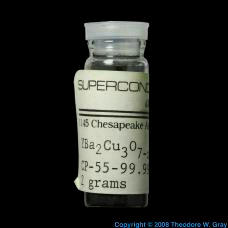
Superconducting powder. This is a small vial of superconducting yttrium-barium-copper-oxide powder. Normally this type of material is seen pressed into pellets that can be used to levitate magnets or perform other superconducting experiments. Background information from the source: Yttrium barium copper oxide was discovered in the late 1980's as being the first known substance to exhibit superconductivity above 77 Kelvin (-321\272F, -195C) outside of a mind-meltingly strong magnetic field. In the grand scheme of things, 77 Kelvin is a completely random value--it has no greater cosmic meaning, it's not an ultimate limit that contradicts some obscure physics theory, nothing like that. Rather, 77 Kelvin is the boiling point of nitrogen. The significance is simply that with the discovery of this material, superconductivity was a phenomenon that suddenly emerged from the realm of "laboratory curiosity" into the wide bright world of "industrially and economically feasible," using liquid nitrogen as a coolant. Previously, liquid hydrogen or liquid helium were necessary to access the temperatures at which superconductivity could be observed (outside of that frog-levitatingly strong magnetic field), both of which are at least an order of magnitude more expensive than liquid nitrogen. Source: Anonymous Contributor: Theodore Gray Acquired: 27 December, 2008 Text Updated: 1 March, 2009 Price: Anonymous Size: 1" Composition: YBa2Cu3O7 |
||||||||||||||||||
Larger | Spin | 3D |
Wet rock from Nanjing. This is a type of rock famous in the Nanjing area of China. It's supposed to be wet: When they sell them in shops there are always a few in a bowl of water, because that makes them look pretty and brings out the colors. Source: China Contributor: Theodore Gray Acquired: 27 December, 2008 Text Updated: 16 April, 2009 Price: $5 Size: 1" Composition: SiO2 |
||||||||||||||||||
Larger | Spin | 3D |
Molybdenum trioxide crystals. These are lovely transparent crystals of molybdenum trioxide which I made myself using nothing more than an acetylene welding torch and a molybdenum plate. Lovely. Just lovely. Too bad I was trying to make diamonds, not molybdenum trioxide. It seems that blowing an ordinary acetylene torch at a molydenum or silicon plate held at the right temperature will cause a thin film of diamond to form slowly on the surface. After my first attempt at this I saw a few tiny flakes of what was unmistably transparent crystal material. Needless to say I was pretty excited by this. Unfortunately, when I continued the experiment I started getting lots and LOTS of this beautiful crystal material, so much that it could not possibly be diamond, since what was expected was a few microns of polycrystalline film, not macroscopic crystals like these. Sadly, it is simply molydenum trioxide, a species that forms in air at high enough temperatures. I'm still working on the diamond making, it will be a Popular Science column if I get it to work. Source: Theodore Gray Contributor: Theodore Gray Acquired: 27 December, 2008 Text Updated: 28 December, 2008 Price: Free Size: 1" Composition: MoO3 |
||||||||||||||||||
| |||||||||||||||||||
Larger | Spin | 3D |
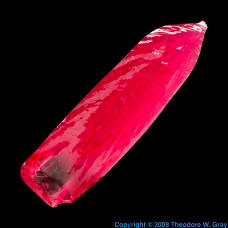
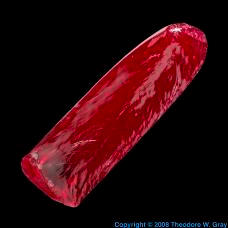
Synthetic ruby boule. This is a lovely synthetic ruby boule cut in half. It's quite large, and said to be intended for use in making a ruby laser. Source: eBay seller phumin2007 Contributor: Theodore Gray Acquired: 27 December, 2008 Text Updated: 28 December, 2008 Price: $10 Size: 2.5" Composition: Al2O3 |
||||||||||||||||||
Larger | Spin | 3D |
Synthetic ruby boule. This is a lovely synthetic ruby boule cut in half. It's quite large, and said to be intended for use in making a ruby laser. Source: eBay seller phumin2007 Contributor: Theodore Gray Acquired: 27 December, 2008 Text Updated: 28 December, 2008 Price: $10 Size: 2.5" Composition: Al2O3 |
||||||||||||||||||
Larger | Spin | 3D |
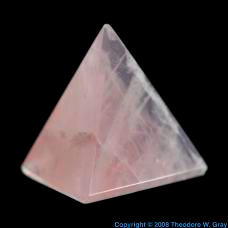
Tetrahedron from Sacred Geometry set. This a decently nice crystal tetrahedron from a set of Platonic solids sold as a "Sacred Geometry" set, made of rose quartz. Nice rocks, but I'm not clear what's "Sacred" about them, they are mathematical objects, not spiritual ones. Source: Unknown Contributor: Theodore Gray Acquired: 27 December, 2008 Text Updated: 16 April, 2009 Price: $35/set Size: 1" Composition: SiO2 |
||||||||||||||||||
Larger |
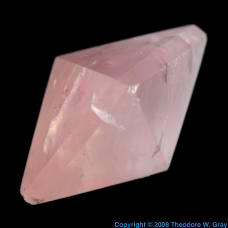
Octahedron from Sacred Geometry set. This a decently nice crystal octahedron from a set of Platonic solids sold as a "Sacred Geometry" set, made of rose quartz. Nice rocks, but I'm not clear what's "Sacred" about them, they are mathematical objects, not spiritual ones. Source: Unknown Contributor: Theodore Gray Acquired: 27 December, 2008 Text Updated: 16 April, 2009 Price: $35/set Size: 1" Composition: SiO2 |
||||||||||||||||||
Larger | Spin | 3D |
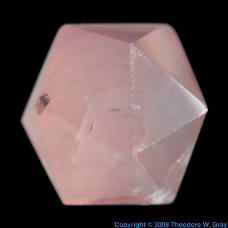
Icosahedron from Sacred Geometry set. This a decently nice crystal icosahedron from a set of Platonic solids sold as a "Sacred Geometry" set, made of rose quartz. Nice rocks, but I'm not clear what's "Sacred" about them, they are mathematical objects, not spiritual ones. Source: Unknown Contributor: Theodore Gray Acquired: 27 December, 2008 Text Updated: 16 April, 2009 Price: $35/set Size: 1" Composition: SiO2 |
||||||||||||||||||
| |||||||||||||||||||
Larger | Spin | 3D |
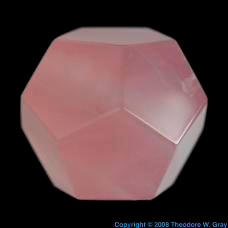
Dodecahedron from Sacred Geometry set. This a decently nice crystal dodecahedron from a set of Platonic solids sold as a "Sacred Geometry" set, made of rose quartz. Nice rocks, but I'm not clear what's "Sacred" about them, they are mathematical objects, not spiritual ones. Source: Unknown Contributor: Theodore Gray Acquired: 27 December, 2008 Text Updated: 16 April, 2009 Price: $35/set Size: 1" Composition: SiO2 |
||||||||||||||||||
Larger | Spin | 3D |
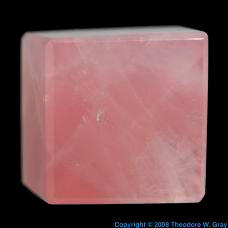
Cube from Sacred Geometry set. This a decently nice crystal cube from a set of Platonic solids sold as a "Sacred Geometry" set, made of rose quartz. Nice rocks, but I'm not clear what's "Sacred" about them, they are mathematical objects, not spiritual ones. Source: Unknown Contributor: Theodore Gray Acquired: 27 December, 2008 Text Updated: 16 April, 2009 Price: $35/set Size: 1" Composition: SiO2 |
||||||||||||||||||
Larger | Spin | 3D |
Ulexite. Description from the source: Ulexite (Na Ca B5 O6 (OH)6x5 H2O tric.), Boron, California, USA. When viewed parallel to the fibers, Ulexite transmits light in a similar fashion to fiber optics. 3,2x1,5x1 cm; 8 g. Source: Simone Citon Contributor: John Gray Acquired: 27 December, 2008 Text Updated: 28 December, 2008 Price: Trade Size: 1.25" Composition: NaCaB5O6(OH)6.5(H2O) |
||||||||||||||||||
Larger | Spin | 3D |
Scolecite. Description from the source: Scolecite (Ca Al2 Si3 O10 x 3 H2 O mon.), Poona, Jalgaon, India. White fascicular, delicate crystals. 5,5x2x1 cm; 3 g. Source: Simone Citon Contributor: John Gray Acquired: 27 December, 2008 Text Updated: 28 December, 2008 Price: Trade Size: 2.2" Composition: CaAl2Si3O10.3(H2O) |
||||||||||||||||||
Larger | Spin | 3D |
Pollucite. Description from the source: Pollucite ((Cs Na)2 Al2 Si4 O12 x H2O cub.), Bennet Quarry, Maine, USA. Pink, massive. 4,5x2,5x1,5 cm; 20 g. Source: Simone Citon Contributor: John Gray Acquired: 27 December, 2008 Text Updated: 28 December, 2008 Price: Trade Size: 1.75" Composition: (CsNa)2Al2Si4O12.H2O |
||||||||||||||||||
| |||||||||||||||||||
Larger | Spin | 3D |
Magnetite. Description from the source: Magnetite (Fe+2 Fe+32 O4 cub.), Potosi, Bolivia. Perfect crystals on matrix. 6x5x2,5 cm; 65 g. Source: Simone Citon Contributor: John Gray Acquired: 27 December, 2008 Text Updated: 28 December, 2008 Price: Trade Size: 2.4" Composition: Fe2O4 |
||||||||||||||||||
Larger | Spin | 3D |
Celestine. Description from the source: Celestine (Sr SO4 orth.), Sakoany Mine, Mahajanga Province, Madagascar. Massive with some face. 3x2x1,4 cm; 12 g;. Source: Simone Citon Contributor: John Gray Acquired: 27 December, 2008 Text Updated: 28 December, 2008 Price: Trade Size: 1.2" Composition: SrSO4 |
||||||||||||||||||
Larger | Spin | 3D |
Stilbite. Description from the source: Ca-Stilbite (Na Ca4 (Al9 Si27 O72)x nH2O mon.), Poona, Jalgaon, Maharashtra, India. White crystal cluster with pulverulent Laumontite. 3,5x1,3x1,3 cm; 5 g. Source: Simone Citon Contributor: John Gray Acquired: 27 December, 2008 Text Updated: 28 December, 2008 Price: Trade Size: 1.4" Composition: NaCa4(Al9Si27O72).H2O |
||||||||||||||||||
Larger | Spin | 3D |
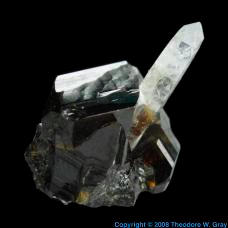
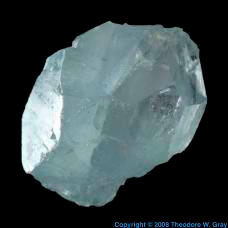
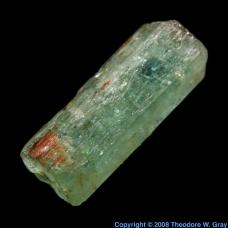
Beryl. Description from the source: Beryl ( Be3 Al2 Si6 O18 hex.), Antsongombato, Antananarivo, Madagascar. Partial crystal with good blue-green color. 2,3x2,1x2 cm; 25 g. Source: Simone Citon Contributor: John Gray Acquired: 27 December, 2008 Text Updated: 28 December, 2008 Price: Trade Size: 1" Composition: Be3Al2Si6O18 |
||||||||||||||||||
Larger | Spin | 3D |
Anhydrite. Description from the source: Anhydrite (Ca SO4 orth.), Naica, Chihuahua, Mexico. Distinct geminated crystals with light lavender color. 5,5x1,8x0,7 cm; 6 g. Source: Simone Citon Contributor: John Gray Acquired: 27 December, 2008 Text Updated: 28 December, 2008 Price: Trade Size: 2" Composition: CaSO4 |
||||||||||||||||||
| |||||||||||||||||||
Larger | Spin | 3D |
Synthetic ruby boule. This is a lovely synthetic ruby boule cut in half. It's quite large, and said to be intended for use in making a ruby laser. Source: eBay seller phumin2007 Contributor: Theodore Gray Acquired: 1 December, 2008 Text Updated: 2 December, 2008 Price: $10 Size: 2.5" Composition: Al2O3 |
||||||||||||||||||
Larger | Spin | 3D |
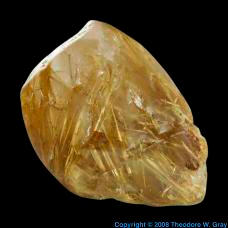
Rutile. Description from the source: Rutile ( Ti O2 tet. ), Novo Horizonte, Bahia, Brazil. Golden, totally included in Quartz partially polished. 3x2,5x2,5 cm; 20 g. Source: Simone Citon Contributor: John Gray Acquired: 19 November, 2008 Text Updated: 20 November, 2008 Price: Trade Size: 1.2" Composition: TiO2 |
||||||||||||||||||
Larger | Spin | 3D |
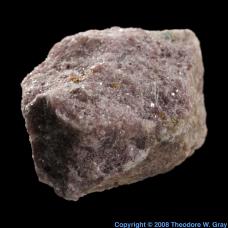
Lepidolite. Description from the source: Lepidolite (K (Li Al)3 (Si Al)4 O10 (F OH)2 mon.), Varutra"sk, Skellefteao, Va"sterbotten, Sweden. Laminar deep purple crystals on matrix. 5x3,5x3 cm; 45 g. Source: Simone Citon Contributor: John Gray Acquired: 19 November, 2008 Text Updated: 20 November, 2008 Price: Trade Size: 2" Composition: K(LiAl)3(SiAl)4O10(FOH)2 |
||||||||||||||||||
Larger | Spin | 3D |
Danburite. Description from the source: Danburite (Ca B2 (SiO4)2 orth.), Charcas, San Luis Potosi`, Mexico. Prismatic, geminated. 4x2x1,5 cm; 16 g. Source: Simone Citon Contributor: John Gray Acquired: 19 November, 2008 Text Updated: 20 November, 2008 Price: Trade Size: 1.6" Composition: CaB2(SiO4)2 |
||||||||||||||||||
Larger | Spin | 3D |
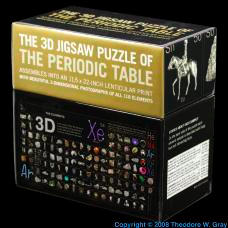
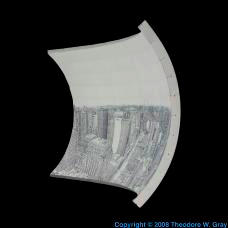
3D Lenticular Periodic Table Puzzle. In late 2006 I published a photo periodic table and it's been selling well enough to encourage me to make new products. This is a 3D lenticular (stereo image) periodic table that's been cut up into puzzle pieces and put into a really nice glossy box. I have to admit it's not my favorite periodic table product: The pieces are a little hard to put together. But people seem to like it. Check out my poster page to read about (and buy!) the puzzle and other periodic table products. Source: Theodore Gray Contributor: Theodore Gray Acquired: 19 November, 2008 Text Updated: 20 November, 2008 Price: $25 Size: 5" Composition: CHO |
||||||||||||||||||
| |||||||||||||||||||
Larger | Spin | 3D |
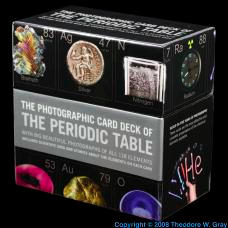
Photo Card Deck of the Elements. In late 2006 I published a photo periodic table and it's been selling well enough to encourage me to make new products. This one is a particularly neat one: A complete card deck of the elements with one big five-inch (12.7cm) square card for every element. If you like this site and all the pictures on it, you'll love this card deck. And of course if you're wondering what pays for all the pictures and the internet bandwidth to let you look at them, the answer is people buying my posters and cards decks. Hint hint. Source: Theodore Gray Contributor: Theodore Gray Acquired: 19 November, 2008 Text Updated: 28 October, 2017 Price: $35 Size: 5" Composition: HHeLiBeBCNOFNeNaMg AlSiPSClArKCaScTiVCrMn FeCoNiCuZnGaGeAsSeBrKr RbSrYZrNbMoTcRuRhPdAg CdInSnSbTeIXeCsBaLaCePr NdPmSmEuGdTbDyHoErTm YbLuHfTaWReOsIrPtAuHgTl PbBiPoAtRnFrRaAcThPaUNp PuAmCmBkCfEsFmMdNoLrRf DbSgBhHsMtDsRgCnNhFlMcLvTsOg |
||||||||||||||||||
Larger | Spin | 3D |
Bastnasite from Jensan Set. This sample represents lanthanum in the "The Grand Tour of the Periodic Table" mineral collection from Jensan Scientifics. Visit my page about element collecting for a general description, or see photographs of all the samples from the set in a periodic table layout or with bigger pictures in numerical order. Source: Jensan Scientifics Contributor: Theodore Gray Acquired: 19 November, 2008 Text Updated: 19 November, 2008 Price: Anonymous Size: 1" Composition: (La,Ce)[F,CO3] |
||||||||||||||||||
Larger | Spin | 3D |
Celestine from Jensan Set. This sample represents strontium in the "The Grand Tour of the Periodic Table" mineral collection from Jensan Scientifics. Visit my page about element collecting for a general description, or see photographs of all the samples from the set in a periodic table layout or with bigger pictures in numerical order. Source: Jensan Scientifics Contributor: Theodore Gray Acquired: 19 November, 2008 Text Updated: 19 November, 2008 Price: Anonymous Size: 1" Composition: SrSO4 |
||||||||||||||||||
Larger | Spin | 3D |
Strontianite. Description from the source: Strontianite (Sr CO3 orth.), Germany. Crystalline mass. 2,5x2x1,5 cm; 15 g with box. Source: Simone Citon Contributor: John Gray Acquired: 30 October, 2008 Text Updated: 31 October, 2008 Price: Trade Size: 1" Composition: SrCO3 |
||||||||||||||||||
Larger | Spin | 3D |
Erythrite. Description from the source: Erythrite (Co3 (AsO4)2x8 H2 O mon.), Dome Rock, South Australia, Australia. With pseudocubic Smolianinovite. 3x2,2x1,5 cm; 7 g. Source: Simone Citon Contributor: John Gray Acquired: 30 October, 2008 Text Updated: 13 March, 2009 Price: Trade Size: 0.75" Composition: Co3(AsO4)2.8H2 O |
||||||||||||||||||
| |||||||||||||||||||
Larger | Spin | 3D |
Manganaxinite. Description from the source: Manganaxinite (Ca2 Mn+2 Al2 B Si4 O15 (OH) tric.), Dalnegorsk, Russia. Brown greenish, bladed crystal cluster. 2,5x2x1,5 cm; 8 g. Source: Simone Citon Contributor: John Gray Acquired: 30 October, 2008 Text Updated: 31 October, 2008 Price: Trade Size: 1" Composition: Ca2Mn+2Al2BSi4O15(OH) |
||||||||||||||||||
Larger | Spin | 3D |
Glauberite. Description from the source: Glauberite (Na2 Ca (SO4)2 mon.), Camp Verde District, Yavapai Co., Arizona, USA. Classic crystal cluster, usually alterated in Gips. 3,7x2,5x2 cm; 5 g. Source: Simone Citon Contributor: John Gray Acquired: 30 October, 2008 Text Updated: 31 October, 2008 Price: Trade Size: 1.5" Composition: Na2Ca(SO4)2 |
||||||||||||||||||
Larger | Spin | 3D |
Elbaite. Description from the source: Elbaite (Na (Li Al)3 Al6 (BO3)3 Si6 O18 (OH)4 trig.), Stak Nala, Haramosh, Skardu, Baltistan, Pakistan. Fascicular crystals on matrix. 4x2,5x1,5 cm; 12 g. Source: Simone Citon Contributor: John Gray Acquired: 30 October, 2008 Text Updated: 31 October, 2008 Price: Trade Size: 1.5" Composition: Na(LiAl)3Al6(BO3)3Si6O18(OH)4 |
||||||||||||||||||
Larger | Spin | 3D |
Cornetite. Description from the source: Cornetite (Cu+23(PO4) (OH)3 orth.), Shaba, Rep. Dem. of Congo. Rare crystal sections on matrix. 3,2x2x0,8 cm; 4 g. Source: Simone Citon Contributor: John Gray Acquired: 30 October, 2008 Text Updated: 31 October, 2008 Price: Trade Size: 1.25" Composition: Cu+23(PO4) (OH)3 |
||||||||||||||||||
Larger | Spin | 3D |
Crocoite from Jensan Set. This sample represents lead in the "The Grand Tour of the Periodic Table" mineral collection from Jensan Scientifics. Visit my page about element collecting for a general description, or see photographs of all the samples from the set in a periodic table layout or with bigger pictures in numerical order. Source: Jensan Scientifics Contributor: Theodore Gray Acquired: 30 October, 2008 Text Updated: 31 October, 2008 Price: Anonymous Size: 1" Composition: Pb(CrO4) |
||||||||||||||||||
| |||||||||||||||||||
Larger | Spin | 3D |
Scheelite from Jensan Set. This sample represents tungsten in the "The Grand Tour of the Periodic Table" mineral collection from Jensan Scientifics. Visit my page about element collecting for a general description, or see photographs of all the samples from the set in a periodic table layout or with bigger pictures in numerical order. Source: Jensan Scientifics Contributor: Theodore Gray Acquired: 30 October, 2008 Text Updated: 31 October, 2008 Price: Anonymous Size: 1" Composition: Ca[WO4] |
||||||||||||||||||
Larger | Spin | 3D |
Pollucite from Jensan Set. This sample represents cesium in the "The Grand Tour of the Periodic Table" mineral collection from Jensan Scientifics. Visit my page about element collecting for a general description, or see photographs of all the samples from the set in a periodic table layout or with bigger pictures in numerical order. Source: Jensan Scientifics Contributor: Theodore Gray Acquired: 30 October, 2008 Text Updated: 31 October, 2008 Price: Anonymous Size: 1" Composition: (Cs,Na)2[Al2Si4O12].2H2O |
||||||||||||||||||
Larger | Spin | 3D |
Pyrochlore from Jensan Set. This sample represents niobium in the "The Grand Tour of the Periodic Table" mineral collection from Jensan Scientifics. Visit my page about element collecting for a general description, or see photographs of all the samples from the set in a periodic table layout or with bigger pictures in numerical order. Source: Jensan Scientifics Contributor: Theodore Gray Acquired: 30 October, 2008 Text Updated: 31 October, 2008 Price: Anonymous Size: 1" Composition: (Ca,Na)2Nb2O6(OH,F) |
||||||||||||||||||
Larger | Spin | 3D |
Eudialyte from Jensan Set. This sample represents zirconium in the "The Grand Tour of the Periodic Table" mineral collection from Jensan Scientifics. Visit my page about element collecting for a general description, or see photographs of all the samples from the set in a periodic table layout or with bigger pictures in numerical order. Source: Jensan Scientifics Contributor: Theodore Gray Acquired: 29 October, 2008 Text Updated: 29 October, 2008 Price: Anonymous Size: 1" Composition: Na15Ca6(FeMn)3Zr3[Si25O73](O,OH,H2O)3(OH,Cl)2 |
||||||||||||||||||
Larger | Spin | 3D |
Borosilicate glass Medallion. I made this medallion for an article in my Popular Science column, using a charcoal grill to melt old borosilicate test tubes down and press them into a graphite mold. Source: Theodore Gray Contributor: Theodore Gray Acquired: 26 October, 2008 Text Updated: 16 April, 2009 Price: $1 Size: 2.5" Composition: SiO2+Na2[B4O5(OH)4] |
||||||||||||||||||
| |||||||||||||||||||
Larger | Spin | 3D |
Soda-lime glass Medallion. I made this medallion for an article in my Popular Science column, using a charcoal grill to melt the ingredients (silica sand, washing soda and limestone) together into soda-lime glass. Once melted I pressed the glass (darkened by ashes from the fire) into a graphite mold I had machined and heated in the fire. Source: Theodore Gray Contributor: Theodore Gray Acquired: 26 October, 2008 Text Updated: 26 October, 2008 Price: $1 Size: 2.5" Composition: SiO2+Na2CO3+CaCO3 |
||||||||||||||||||
Larger | Spin | 3D |
Spessartite. Description from the source: Spessartite (Mn+23 Al2 (Si O4)3 cub.), Tongbei, Yunxiao, Fujian, China. Perfect crystals on matrix. 5x3,5x3 cm; 50 g. Source: Simone Citon Contributor: John Gray Acquired: 26 October, 2008 Text Updated: 26 October, 2008 Price: Trade Size: 2" Composition: Mn+23Al2(SiO4)3 |
||||||||||||||||||
Larger | Spin | 3D |
Manganese oxides in quartz. Description from the source: Mn oxides included in Quartz. Minas Gerais, Brazil. 6x2,5x2,5 cm; 40 g. Source: Simone Citon Contributor: John Gray Acquired: 26 October, 2008 Text Updated: 26 October, 2008 Price: Trade Size: 2.4" Composition: MnO2+SiO2 |
||||||||||||||||||
Larger | Spin | 3D |
Huebnerite. Description from the source: Huebnerite (Mn+2 WO4 mon.), Huayllapon Mine, Pasto Bueno, Ancash, Peru. Very nice biterminated crystal, black reddish, with Quartz, high lustre. 6,5x3,5x1,8 cm; 82 g. Source: Simone Citon Contributor: John Gray Acquired: 26 October, 2008 Text Updated: 16 March, 2009 Price: Trade Size: 2.5" Composition: MnWO4 |
||||||||||||||||||
Larger | Spin | 3D |
Atacamite. Description from the source: Atacamite (Cu+2 2 Cl (OH)3 orth.), La Farola Mine, Tierra Amarilla, Atacama, Chile. Dark green acicular crystals on matrix. 6x4x2 cm; 52 g. Source: Simone Citon Contributor: John Gray Acquired: 26 October, 2008 Text Updated: 28 April, 2009 Price: Trade Size: 2.35" Composition: Cu2[(OH)3|Cl] |
||||||||||||||||||
| |||||||||||||||||||
Larger | Spin | 3D |
Wulfenite. Description from the source: Wulfenite (Pb Mo O4 tet.), Red Cloud Mine, Arizona, USA. Perfect crystal. 1,3x1,2x0,4 cm; 10 g with box. Source: Simone Citon Contributor: John Gray Acquired: 26 October, 2008 Text Updated: 26 October, 2008 Price: Trade Size: 0.5" Composition: PbMoO4 |
||||||||||||||||||
Larger | Spin | 3D |
Sulphohalite. Description from the source: Sulphohalite ( Na6 (SO4)2 F Cl cub.), Searles Lake, California, USA. Perfect octahedral crystal, much better than the photo, rare. 2x1,8x1,5 cm; 12 g with box. Source: Simone Citon Contributor: John Gray Acquired: 26 October, 2008 Text Updated: 26 October, 2008 Price: Trade Size: 0.75" Composition: Na6(SO4)2FCl |
||||||||||||||||||
Larger | Spin | 3D |
Staurolite. Description from the source: Staurolite ((Fe+2 Mg Zn)2 Al9 (Si Al)4 O22 (OH)2 mon.), New Mexico, USA. Geminated with small garnets. 1,5x1,4x1,1 cm; 6 g. Source: Simone Citon Contributor: John Gray Acquired: 26 October, 2008 Text Updated: 26 October, 2008 Price: Trade Size: 0.6" Composition: (FeMgZn)2Al9(SiAl)4O22(OH)2 |
||||||||||||||||||
Larger | Spin | 3D |
Smithsonite. Description from the source: Smithsonite (Zn CO3 trig.), Monroe Co., USA. Botryoidal, translucent crystals on matrix. 1,5x1,5x1 cm; 9 g with box. Source: Simone Citon Contributor: John Gray Acquired: 26 October, 2008 Text Updated: 26 October, 2008 Price: Trade Size: 0.6" Composition: ZnCO3 |
||||||||||||||||||
Larger | Spin | 3D |
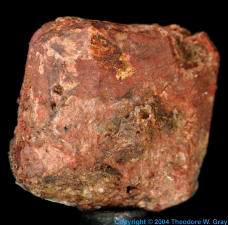
Phenakite. Description from the source: Phenakite (Be2 SiO4 trig.), Madagascar. Isolated, prismatic, geminated. 1,9x1,4x1,2 cm; 8 g. Source: Simone Citon Contributor: John Gray Acquired: 26 October, 2008 Text Updated: 26 October, 2008 Price: Trade Size: 0.75" Composition: Be2SiO4 |
||||||||||||||||||
| |||||||||||||||||||
Larger | Spin | 3D |
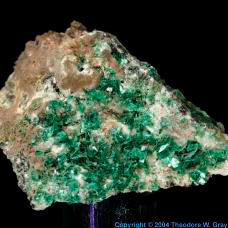
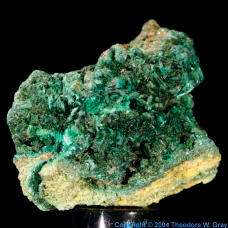
Malachite. Description from the source: Malachite (Cu+22 (CO3) (OH)2 mon.), Germany. Acicular crystals on limonitic matrix. 2,5x1,5x1,2 cm; 12 g with box. Source: Simone Citon Contributor: John Gray Acquired: 14 October, 2008 Text Updated: 14 October, 2008 Price: Trade Size: 1" Composition: Cu+22(CO3)(OH)2 |
||||||||||||||||||
Larger | Spin | 3D |
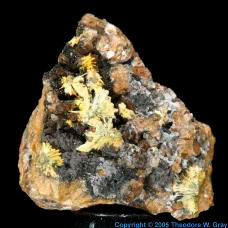
Kleinite. Description from the source: Kleinite ( Hg2 N (Cl SO4)\[CenterDot]n H2O hex.), McDermitt Mine, Humboldt Co., Nevada, USA. Yellow crusts on Quartz. 1,8x1x1 cm; 5 g with box. Source: Simone Citon Contributor: John Gray Acquired: 14 October, 2008 Text Updated: 14 October, 2008 Price: Trade Size: 0.7" Composition: Hg2N(ClSO4).H2O |
||||||||||||||||||
Larger | Spin | 3D |
Gehlenite. Description from the source: Gehlenite ( Ca2 Al (Al Si) O7 tet.), Le Selle, Monzoni, Trento, Italy. Small but evident. 1,5x1x1 cm; 3 g with box. Source: Simone Citon Contributor: John Gray Acquired: 14 October, 2008 Text Updated: 14 October, 2008 Price: Trade Size: 0.6" Composition: Ca2Al(AlSi)O7 |
||||||||||||||||||
Larger | Spin | 3D |
Diopside. Description from the source: Diopside (Ca Mg Si2 O6 mon.), Jalpur, India. Green, geminated crystals. 2x1,2x1 cm; 5 g. Source: Simone Citon Contributor: John Gray Acquired: 14 October, 2008 Text Updated: 14 October, 2008 Price: Trade Size: 0.75" Composition: CaMgSi2O6 |
||||||||||||||||||
Larger | Spin | 3D |
Yellow Pyroxene. Description from the source: A very rare "yellow" Pyroxene (probably an Aegyrine/Augite, Vesuvio, Napoli, Italia), with a incredible intense yellow color, associated with reddish Olivine and black Spinell. An extremely good Vesuvious specimen for the collectors. 4x2,5x2 cm; 22 g. Source: Simone Citon Contributor: John Gray Acquired: 30 September, 2008 Text Updated: 1 October, 2008 Price: Trade Size: 1.6" Composition: CaMg(Si2O6) |
||||||||||||||||||
| |||||||||||||||||||
Larger | Spin | 3D |
Hemimorphite. Description from the source: Hemimorphite (Zn4 Si2 O7 (OH)2 x H2 O orth.), Ojuela Mine, Mapimi`, Durango, Mexico. Transparent, perfect crystals on limonitic matrix. 4,5x3x2 cm; 22 g. Source: Simone Citon Contributor: John Gray Acquired: 30 September, 2008 Text Updated: 1 October, 2008 Price: Trade Size: 1.75" Composition: Zn4Si2O7(OH)2.H2O |
||||||||||||||||||
Larger | Spin | 3D |
Scheelite. Description from the source: Scheelite (Ca WO4 tet.), Volchiy Mine, Chukotka Okrug, Russia. Very nice little example, with Scheelite octahedral crystals and black Cassiterite. 2x1,5x1,6 cm; 15 g. Source: Simone Citon Contributor: John Gray Acquired: 30 September, 2008 Text Updated: 1 October, 2008 Price: Trade Size: 0.75" Composition: CaWO4 |
||||||||||||||||||
Larger | Spin | 3D |
Cassiterite. Description from the source: Cassiterite (Sn O2 tet.), Huanuni, Bolivia. Similar, only Cassiterite. 2,5x2x2 cm; 20 g. Source: Simone Citon Contributor: John Gray Acquired: 30 September, 2008 Text Updated: 1 October, 2008 Price: Trade Size: 1" Composition: SnO2 |
||||||||||||||||||
Larger | Spin | 3D |
Cassiterite. Description from the source: Cassiterite (Sn O2 tet.), Huanuni, Bolivia. Crystal cluster with Pyrite. 2,5x2x1,6 cm; 20 g. Source: Simone Citon Contributor: John Gray Acquired: 30 September, 2008 Text Updated: 1 October, 2008 Price: Trade Size: 1" Composition: SnO2 |
||||||||||||||||||
Larger | Spin | 3D |
Forsterite. Description from the source: Forsterite (Mg2 SiO4 orth.), Minas Gerais, Brazil. Granular. 2x1,2x1,2 cm; 3 g. Source: Simone Citon Contributor: John Gray Acquired: 30 September, 2008 Text Updated: 1 October, 2008 Price: Trade Size: 0.75" Composition: Mg2SiO4 |
||||||||||||||||||
| |||||||||||||||||||
Larger | Spin | 3D |
Apatite. Description from the source: Apatite (Ca5 (PO4)3 F hex.), Otter Lake, Quebec, Canada. Isolated well formed crystal with high lustre. 4,5x2,5x1,5 cm; 35 g. Source: Simone Citon Contributor: John Gray Acquired: 30 September, 2008 Text Updated: 1 October, 2008 Price: Trade Size: 1.75" Composition: Ca5(PO4)3F |
||||||||||||||||||
Larger | Spin | 3D |
Pyroxmangite. Description from the source: Pyroxmangite (Mn+2 Si O3 tric. ), Conselheiro Lafaiete, Minas Gerais, Brazil. Massive, cleavaged. 8,5x4,5x1,5 cm; 70 g. Source: Simone Citon Contributor: John Gray Acquired: 30 September, 2008 Text Updated: 1 October, 2008 Price: Trade Size: 3.3" Composition: MnSiO3 |
||||||||||||||||||
Larger | Spin | 3D |
Rhodochrosite. Description from the source: Rhodochrosite (Mn+2 CO3 trig.), Pachapaqui, Ancash, Peru. Nice pink crystal clusters. 4x4x2 cm; 40 g. Source: Simone Citon Contributor: John Gray Acquired: 30 September, 2008 Text Updated: 1 October, 2008 Price: Trade Size: 1.6" Composition: MnCO3 |
||||||||||||||||||
Larger | Spin | 3D |
Spinel. Description from the source: Spinel (Mg Al O4 cub.), Parker Mine, Notre Dame du Laus, Quebec, Canada. Black crystals on matrix with Forsterite. 5x4x3,5 cm; 90 g. Source: Simone Citon Contributor: John Gray Acquired: 30 September, 2008 Text Updated: 1 October, 2008 Price: Trade Size: 2" Composition: MgAlO4 |
||||||||||||||||||
Larger | Spin | 3D |
Magnesite. Description from the source: Magnesite (Mg CO3 trig.), Sierra de los Brumado, Bahia, Brazil. Very nice crystals cluster with Tourmaline Uvite. 3x2,5x2,5 cm; 16 g. Source: Simone Citon Contributor: John Gray Acquired: 30 September, 2008 Text Updated: 1 October, 2008 Price: Trade Size: 1.2" Composition: MgCO3 |
||||||||||||||||||
| |||||||||||||||||||
Larger | Spin | 3D |
Petalite. Description from the source: Petalite (Li Al Si4 O10 mon.), Mogok, Myanmar (Burma). Isolated, fracturated beige crystal, rare. 2,5x1,6x1 cm; 5 g. Source: Simone Citon Contributor: John Gray Acquired: 30 September, 2008 Text Updated: 1 October, 2008 Price: Trade Size: 1" Composition: LiAlSi4O10 |
||||||||||||||||||
Larger | Spin | 3D |
Orthoclase. Description from the source: Orthoclase (K Al Si3 O8 mon.), San Gotthard, Tessin, Switzerland. Geminated crystals of the variety Adular. 5x4x3 cm; 25 g. Source: Simone Citon Contributor: John Gray Acquired: 30 September, 2008 Text Updated: 1 October, 2008 Price: Trade Size: 2" Composition: KAlSi3O8 |
||||||||||||||||||
Larger | Spin | 3D |
Siderite. Description from the source: Siderite (Fe+2 CO3 trig.), Bad Ems, Germany. Cleavaged masses, typic. 3,6x2x2 cm the bigger; 36 g all. Source: Simone Citon Contributor: John Gray Acquired: 30 September, 2008 Text Updated: 1 October, 2008 Price: Trade Size: 1.4" Composition: FeCO3 |
||||||||||||||||||
Larger | Spin | 3D |
Crocoite. Description from the source: Crocoite (Pb Cr O4 mon.), Adelaide Mine, Dundas, Tasmania, Australia. Classic red orange elongated crystals on limonitic matrix. 7x4,5x3 cm; 72 g. Source: Simone Citon Contributor: John Gray Acquired: 30 September, 2008 Text Updated: 1 October, 2008 Price: Trade Size: 2.75" Composition: PbCrO4 |
||||||||||||||||||
Larger | Spin | 3D |
Calcite. Description from the source: Calcite (Ca CO3 trig.), Pinzgau, Austria. Classic crystal clusters. 2,5x1,8x1,5 cm; 11 g with box. Source: Simone Citon Contributor: John Gray Acquired: 30 September, 2008 Text Updated: 1 October, 2008 Price: Trade Size: 1" Composition: CaCO3 |
||||||||||||||||||
| |||||||||||||||||||
Larger | Spin | 3D |
Aragonite. Description from the source: Aragonite (Ca CO3 orth.), Molina de Aragon, Guadalajara, Spagna. Perfect, geminated, green and purple large crystal. 5x5x3,3 cm; 132 g. Source: Simone Citon Contributor: John Gray Acquired: 30 September, 2008 Text Updated: 1 October, 2008 Price: Trade Size: 2" Composition: CaCO3 |
||||||||||||||||||
Larger | Spin | 3D |
Grossular. Description from the source: Grossular (Ca3 Al2 (Si O4)3 cub.), Lake Jako, Sierra de las Cruces, Chihuahua, Mexico. Perfect rhombohedral crystal. 2,2x2x1,8 cm; 16 g. Source: Simone Citon Contributor: John Gray Acquired: 30 September, 2008 Text Updated: 1 October, 2008 Price: Trade Size: 1" Composition: Ca3Al2(SiO4)3 |
||||||||||||||||||
Larger | Spin | 3D |
Bismuthite. Description from the source: Bismuthite (Bi2 (CO3) O2 tet.), Beresovsk, Urals, Russia. Prismatic, elongated, light green crystals as alteration on bismuth sulphosalts, associated with very small Gold masses. 4x2,5x2,5 cm; 33 g. Source: Simone Citon Contributor: John Gray Acquired: 30 September, 2008 Text Updated: 1 October, 2008 Price: Trade Size: 1.6" Composition: Bi2(CO3)O2 |
||||||||||||||||||
Larger | Spin | 3D |
Chrysoberyl. Description from the source: Chrysoberyl (Be Al2 O4 orth.), Colatinha, Espirito Santo, Brazil. Geminated, purple-greenish color. 2,2x2x1,2 cm; 10 g. Source: Simone Citon Contributor: John Gray Acquired: 30 September, 2008 Text Updated: 1 October, 2008 Price: Trade Size: 1" Composition: BeAl2O4 |
||||||||||||||||||
Larger | Spin | 3D |
Beryl. Description from the source: Beryl ( Be3 Al2 Si6 O18 hex.), Governador Valadares, Minas Gerais, Brazil. Not terminated cristal on Quartz with decent color. 6x4,5x4 cm (crystal up to 22 mm); 126 g. Source: Simone Citon Contributor: John Gray Acquired: 30 September, 2008 Text Updated: 1 October, 2008 Price: Trade Size: 2.4" Composition: Be3Al2Si6O18 |
||||||||||||||||||
| |||||||||||||||||||
Larger | Spin | 3D |
Baryte. Description from the source: Baryte (Ba SO4 orth.), Julcani Mine, Huancavelica, Peru. Tabular crystal cluster. 3,5x3,5x2 cm; 22 g. Source: Simone Citon Contributor: John Gray Acquired: 30 September, 2008 Text Updated: 1 October, 2008 Price: Trade Size: 1.4" Composition: BaSO4 |
||||||||||||||||||
Larger | Spin | 3D |
Danburite. Description from the source: Danburite (Ca B2 (SiO4)2 orth.), Charcas, San Luis Potosi`, Mexico. White large terminated crystal. 7x4x1,8 cm; 70 g. Source: Simone Citon Contributor: John Gray Acquired: 30 September, 2008 Text Updated: 1 October, 2008 Price: Trade Size: 2.75" Composition: CaB2(SiO4)2 |
||||||||||||||||||
Larger | Spin | 3D |
Wavellite. Description from the source: Wavellite (Al3 (PO4)2 (OH,F)3x5H2O orth.), Maulding, Montgomery, Arkansas, USA. Nice spherical crystal clusters on matrix with green color, better than the photo. 7,2x4x3,5 cm; 63 g. Source: Simone Citon Contributor: John Gray Acquired: 30 September, 2008 Text Updated: 1 October, 2008 Price: Trade Size: 2.8" Composition: Al3(PO4)2(OH,F)3.5H2O |
||||||||||||||||||
Larger | Spin | 3D |
Staurolite. Description from the source: Staurolite ((Fe+2 Mg Zn)2 Al9 (Si Al)4 O22 (OH)2 mon.), Minas Gerais, Brazil. Single crystal. 1,8x1,5x1,2 cm; 5 g. Source: Simone Citon Contributor: John Gray Acquired: 30 September, 2008 Text Updated: 1 October, 2008 Price: Trade Size: 0.7" Composition: (FeMgZn)2Al9(SiAl)4O22(OH)2 |
||||||||||||||||||
Larger | Spin | 3D |
Rutile. Description from the source: Rutile ( Ti O2 tet. ), Ibitiara, Bahia, Brazil. Yellow epitaxial elongated crystals on Hematite. 2,2x1,4x0,8 cm; 8 g with box. Source: Simone Citon Contributor: John Gray Acquired: 30 September, 2008 Text Updated: 1 October, 2008 Price: Trade Size: 1" Composition: TiO2 |
||||||||||||||||||
| |||||||||||||||||||
Larger | Spin | 3D |
Euxenite. Description from the source: Euxenite ( (Y Ca Ce U Th) (Nb Ta Ti)2 O6 orth.), Trout Creek Pass, Chafee Co. Colorado, USA. Crystal cluster, nice and rare example. 2x1,5x1 cm; 14 g with box. Source: Simone Citon Contributor: John Gray Acquired: 30 September, 2008 Text Updated: 1 October, 2008 Price: Trade Size: 0.75" Composition: (YCaCeUTh)(NbTaTi)2O6 |
||||||||||||||||||
Larger | Spin | 3D |
Vesuvianite. Description from the source: Vesuvianite (Ca10 Mg2 Al4 (SI O4)5 (Si2 O7)2 (OH)4 tet.), Bellecombe, Aosta, Italia. Perfect isolated crystal. 1,2x0,8x0,8 cm; 3 g. Source: Simone Citon Contributor: John Gray Acquired: 30 September, 2008 Text Updated: 1 October, 2008 Price: Trade Size: 0.5" Composition: Ca10Mg2Al4(SiO4)5(Si2O7)2(OH)4 |
||||||||||||||||||
Larger | Spin | 3D |
Zirconolite. Description from the source: Zirconolite var. Polymignite ((Ca Fe Y Th) (Nb Ti Ta Zr) O4 orth.), Stavern (Fredriksva"rn), Larvik, Vestfold, Norway. Black, fractured on matrix. 2,5x1,4x1,2 cm; 3 g. Source: Simone Citon Contributor: John Gray Acquired: 30 September, 2008 Text Updated: 1 October, 2008 Price: Trade Size: 1" Composition: (CaFeYTh)(NbTiTaZr)O4 |
||||||||||||||||||
Larger | Spin | 3D |
Magnesite. Description from the source: Magnesite (Mg CO3 trig.), Steiermark, Austria. White botryoidal masses. 2,5x1,8x1,5 cm; 12 g with box. Source: Simone Citon Contributor: John Gray Acquired: 30 September, 2008 Text Updated: 1 October, 2008 Price: Trade Size: 1" Composition: MgCO3 |
||||||||||||||||||
Larger | Spin | 3D |
Azurite. Description from the source: Azurite (Cu+23 (CO3)2 (OH)2 mon.), Ajo, Pima Co., Arizona, USA. Well definited crystals on matrix. 1,8x1,5x1 cm; 8 g. Source: Simone Citon Contributor: John Gray Acquired: 30 September, 2008 Text Updated: 1 October, 2008 Price: Trade Size: 0.7" Composition: Cu+23(CO3)2(OH)2 |
||||||||||||||||||
| |||||||||||||||||||
Larger | Spin | 3D |
Azurite. Description from the source: Azurite (Cu+23 (CO3)2 (OH)2 mon.), La Sal, Utah, USA. Blue crystal cluster. 1,7x1,5x1,1 cm; 4 g. Source: Simone Citon Contributor: John Gray Acquired: 30 September, 2008 Text Updated: 1 October, 2008 Price: Trade Size: 0.65" Composition: Cu+23(CO3)2(OH)2 |
||||||||||||||||||
Larger | Spin | 3D |
Cerite. Description from the source: Cerite ( (Ce Ca)10 (Si O4)6 (OH F)5 trig.), Mine of Bastnaes near Riddarhytta, Westmanland, Sweden. Pinkish masses on matrix. Rare. 2x1,7x0,8 cm; 8 g with box. Source: Simone Citon Contributor: John Gray Acquired: 30 September, 2008 Text Updated: 1 October, 2008 Price: Trade Size: 0.75" Composition: (CeCa)10(SiO4)6(OH.F)5 |
||||||||||||||||||
Larger | Spin | 3D |
Baryte. Description from the source: Baryte (Ba SO4 orth.), Miraflores Mine, Huanuco, Peru. Small but gem crystals, very nice. 0,8x0,8x0,2 cm; 10 g with box. Source: Simone Citon Contributor: John Gray Acquired: 30 September, 2008 Text Updated: 1 October, 2008 Price: Trade Size: 0.3" Composition: BaSO4 |
||||||||||||||||||
Larger | Spin | 3D |
Wavellite. Description from the source: Wavellite (Al3 (PO4)2 (OH,F)3x5H2O orth.), Tom's Quarry, Kapunda, South Australia, Australia. Radiating colorless crystals on limonitic matrix, from a rich in phosphates locality. 1,9x1x0,8 cm; 3 g. Source: Simone Citon Contributor: John Gray Acquired: 30 September, 2008 Text Updated: 1 October, 2008 Price: Trade Size: 0.75" Composition: Al3(PO4)2(OH,F)3.5H2O |
||||||||||||||||||
Larger | Spin | 3D |
Celestine. Description from the source: Celestine (Sr SO4 orth.), Sakoany Mine, Mahajanga Province, Madagascar. Nice lustrpus specimen. 3x3x1,5 cm; 10 g. Source: Simone Citon Contributor: John Gray Acquired: 26 September, 2008 Text Updated: 29 September, 2008 Price: Trade Size: 1.2" Composition: SrSO4 |
||||||||||||||||||
| |||||||||||||||||||
Larger | Spin | 3D |
Quartz. Description from the source: Quartz (Si O2 trig.), Magaliesberg Quartz deposits, Mpumalanga, South Africa. Nice cluster of Quartz "Spirit". 3,5x2,7x2,5 cm; 22 g. Source: Simone Citon Contributor: John Gray Acquired: 26 September, 2008 Text Updated: 28 September, 2008 Price: Trade Size: 0.75" Composition: SiO2 |
||||||||||||||||||
Larger | Spin | 3D |
Quartz. Description from the source: Quartz (SiO2 trig.), San Luis Potosi`, Mexico. Perfect biterminated crystal. 3,5x2,5x2,1 cm; 15 g. Source: Simone Citon Contributor: John Gray Acquired: 26 September, 2008 Text Updated: 28 September, 2008 Price: Trade Size: 1.4" Composition: SiO2 |
||||||||||||||||||
Larger | Spin | 3D |
Fluellite. Description from the source: Fluellite (Al2(PO4)F2(OH).7H2O orth.), Tom's Quarry, Kapunda, South Australia, Australia. Rare crystals on the phosphatic matrix. 3x2,7x2 cm; 15 g. Source: Simone Citon Contributor: John Gray Acquired: 26 September, 2008 Text Updated: 28 September, 2008 Price: Trade Size: 1.2" Composition: Al2(PO4)F2(OH).7H2O |
||||||||||||||||||
Larger | Spin | 3D |
Eudyalite. Description from the source: Eudyalite (Na4(CaCe)2(Fe+2Mn+2Y+ZrSi8O22(OHCl)2 trig.), Kipawa Alcalyne Complex, Villedieu Tow., Quebec, Canada. Red, granular, with white fibrous Agrellite and beige Vlasovite. A rich thumbnail. 2,2x1,7x1 cm; 5 g. Source: Simone Citon Contributor: John Gray Acquired: 26 September, 2008 Text Updated: 28 September, 2008 Price: Trade Size: 0.85" Composition: Na4(CaCe)2(Fe,2Mn,2Y).ZrSi8O22(OHCl)2 |
||||||||||||||||||
Larger | Spin | 3D |
Manganite. Description from the source: Manganite (Mn+3O(OH) mon.), Ilfeld, Harz, Germany. Very good crystals in matrix. 4x3,5x2,5 cm; 15 g. Source: Simone Citon Contributor: John Gray Acquired: 26 September, 2008 Text Updated: 28 September, 2008 Price: Trade Size: 1.6" Composition: Mn.3O(OH) |
||||||||||||||||||
| |||||||||||||||||||
Larger | Spin | 3D |
Alunite. Description from the source: Alunite (KAl3(SO4)2(OH)6 trig.), La Tolfa, Civitavecchia, Lazio, Italy. Small crystal clusters on the same massive material from a classic italian locale. 3,8x2,2x1,5; 22 g. Source: Simone Citon Contributor: John Gray Acquired: 26 September, 2008 Text Updated: 28 September, 2008 Price: Trade Size: 1.5" Composition: KAl3(SO4)2(OH)6 |
||||||||||||||||||
Larger | Spin | 3D |
Aurichalcite. Description from the source: Aurichalcite ( (Zn Cu+2)5 (CO3)2 (OH)6 orth.), Mapimi`, Mexico. Inclusions on Calcite. 2,5x2,5x1,5 cm; 12 g with box. Source: Simone Citon Contributor: John Gray Acquired: 26 September, 2008 Text Updated: 29 September, 2008 Price: Trade Size: 1" Composition: (ZnCu)5(CO3)2(OH)6 |
||||||||||||||||||
Larger | Spin | 3D |
Hydroxilherderite. Description from the source: Hydroxilherderite (CaBe(PO4).(OH) mon.), Linopolis, Minas Gerais, Brazil. Geminated, good rare crystal. 3,2x2x1,5 cm; 10 g. Source: Simone Citon Contributor: John Gray Acquired: 26 September, 2008 Text Updated: 28 September, 2008 Price: Trade Size: 1.25" Composition: CaBe(PO4).(OH) |
||||||||||||||||||
Larger | Spin | 3D |
Corundum (aluminum oxide). Description from the source: Corundum (Al2 O3 trig.), India. Rough, complete, a bit deformed, as a horn. 4,5x2x1,8 cm; 34 g. Source: Simone Citon Contributor: John Gray Acquired: 26 September, 2008 Text Updated: 28 September, 2008 Price: Trade Size: 1.75" Composition: Al2O3 |
||||||||||||||||||
Larger | Spin | 3D |
Kyanite. Description from the source: Kyanite (Al2SiO5 tric.), Itinga, Brazil. Rare complete crystals with transparence. 3,1x1,4x0,9 cm the bigger; 35 g all. Source: Simone Citon Contributor: John Gray Acquired: 26 September, 2008 Text Updated: 28 September, 2008 Price: Trade Size: 1.2" Composition: Al2SiO5 |
||||||||||||||||||
| |||||||||||||||||||
Larger | Spin | 3D |
Ruby Corundum. Description from the source: Corundum var. Ruby (Al2O3 trig.), Mysore, India. Perfect crystal on matrix. 3,2x2,5x2 cm (up to 14 mm the crystal); 20 g. Source: Simone Citon Contributor: John Gray Acquired: 26 September, 2008 Text Updated: 28 September, 2008 Price: Trade Size: 0.5" Composition: Al2O3 |
||||||||||||||||||
Larger | Spin | 3D |
Corundum (aluminum oxide). Description from the source: Corundum (Al2O3 trig.), India. Partially levigated to highlight the cat's-eye effect. Purple-bluish color, very nice. 4x3x2 cm; 57 g. Source: Simone Citon Contributor: John Gray Acquired: 26 September, 2008 Text Updated: 28 September, 2008 Price: Trade Size: 1.6" Composition: Al2O3 |
||||||||||||||||||
Larger | Spin | 3D |
Cicada killer. Another bug donated by my assistant Nick. Look at the size of the stinger on that thing! I'm not much of a bug expert but my understanding is that these things kill and eat cicadas: I'm not sure what happens if they turn on you. Source: Nick Mann Contributor: Nick Mann Acquired: 27 October, 2007 Text Updated: 27 September, 2008 Price: Donated Size: 1" Composition: C(H2O) |
||||||||||||||||||
Larger | Spin | 3D |
Trinitite. Nuclearon specializes in trinitite and other interesting radioactive artifacts and objects. They donated this lovely sample of green glass trinitite, remnants of the Trinity test, the first nuclear explosion created by the hand of man. More details about the origin and characteristics of trinitite can be found at this page about the varieties of trinitite. Interestingly, I got this sample right around the time I exchanged some email with Ellen Klages, the author of The Green Glass Sea, a children's book about the trinity test. The title of the book certainly evokes the nature of this amazing material. Source: Nuclearon Contributor: Nuclearon Acquired: 13 June, 2008 Text Updated: 14 June, 2008 Price: Donated Size: 1" Composition: SiO2 |
||||||||||||||||||
Larger | Spin | 3D |
Trinitite. Nuclearon specializes in trinitite and other interesting radioactive artifacts and objects. They donated this lovely sample of green glass trinitite, remnants of the Trinity test, the first nuclear explosion created by the hand of man. More details about the origin and characteristics of trinitite can be found at this page about the varieties of trinitite. Interestingly, I got this sample right around the time I exchanged some email with Ellen Klages, the author of The Green Glass Sea, a children's book about the trinity test. The title of the book certainly evokes the nature of this amazing material. Source: Nuclearon Contributor: Nuclearon Acquired: 13 June, 2008 Text Updated: 14 June, 2008 Price: Donated Size: 1" Composition: SiO2 |
||||||||||||||||||
| |||||||||||||||||||
Larger | Spin | 3D |
Fancy chocolate tin. This chocolate tin is a sign of the beginning of the end of good chocolate. It's a tin of Hershey's dark chocolate advertised as 65% cocoa. Promoting chocolate on the basis of its percentage of cocoa is an increasingly common marketing tactic, marred only by the fact that beyond about 50% more cocoa means worse chocolate. 99% chocolate, which is actually available, is basically impossible to eat. The force at work here is snobbery, and the need for something that tastes really bad to base the snobbery on. (Things that actually taste good are of no use to snobs, because anyone can appreciate them.) The same force is responsible for vast amounts of perfectly good grape juice being allowed to go sour and become wine. Basically, when you get right down to it, wine does not taste very good. But you can't show off how sophisticated you are by appreciating fine grape juice because pretty much everyone likes it. It tastes good. Wine, on the other hand, tastes bad, so if you go around claiming that you appreciate it at some higher level, and can in even tell the difference between minutely different varieties of it, you can appear refined and sophisticated to the naive who have not yet learned to pretend to like it. Chocolate used to be about tasting good: In this regard milk chocolate is obviously superior. Now all sorts of people turn their nose up at milk chocolate and sniff that they only consume fine dark chocolate. No less than 80% cocoa please. If you ask why they would want to eat that bitter crap suitable only for baking or mixing with milk to make an edible confection, they start talking about fruity aromas and what year the cocoa beans were harvested. Get the picture? They are chocolate snobs who, exactly like wine snobs, actually don't much like the stuff either, but prefer artificial superiority to genuine enjoyment. It's a sad day when this attitude infects even Hershey's, long the bastion of low-brow but good-tasting milk chocolate. How long will it be before there are whole stored dedicated to inedible dark chocolate sorted by vintage, while those seeking the simple pleasure of good chocolate have to turn to the back isles of the grocery store, next to the grape juice? Source: Grocery Store Contributor: Theodore Gray Acquired: 8 March, 2008 Text Updated: 8 March, 2008 Price: $4 Size: 4" Composition: CHO |
||||||||||||||||||
Larger | Spin | 3D |
Elemental Hexagon Cards. This is a lovely little deck of Elemental Hexagon Cards. They are intended for divination purposes similar to the way you would use Tarot cards. A skilled and sensitive interpreter can tell you a lot about yourself using a deck of cards. Or a box of tea leaves or an old rubber tire, so why not element cards? They are pretty and inventive: This is a mass-produced version printed on standard playing card paper. See the previous sample for a custom-printed version. You can get them here. Source: Calyxa Contributor: Theodore Gray Acquired: 8 March, 2008 Text Updated: 8 March, 2008 Price: $30 Size: 3" Composition: CHO |
||||||||||||||||||
Larger | Spin | 3D |
Custom Elemental Hexagon Cards. This is a lovely little deck of Elemental Hexagon Cards. They are intended for divination purposes similar to the way you would use Tarot cards. A skilled and sensitive interpreter can tell you a lot about yourself using a deck of cards. Or a box of tea leaves or an old rubber tire, so why not element cards? They are pretty and inventive: This is a "custom" deck, meaning you get to choose the color and backgrounds. See the next sample for the mass-produced version. You can get them here. Source: Calyxa Contributor: Theodore Gray Acquired: 8 March, 2008 Text Updated: 8 March, 2008 Price: $45 Size: 3" Composition: CHO |
||||||||||||||||||
Larger | Spin | 3D |
Electromagnetic Sensor. Ah, this brings back memories. I made this thing some time in high school: It's supposed to be a general purpose "microphone" for electric or magnetic fields or vibrating metal parts. I turned the handle on a little toy wood lathe, and got a coil of fine wire from a small electric motor. Behind the coil are a couple of permanent magnets from Radio Shack. If you connect it (using the RCA jack at the base of the handle) to an audio amplifier you can actually hear things when you hold it near something that's producing oscillating fields (e.g. a speaker, electric appliance, etc). The idea behind the permanent magnets is to make it work with any vibrating metal, not just electrically-active objects, but that part never really worked as well as I'd hoped. Source: Theodore Gray Contributor: Theodore Gray Acquired: 23 December, 2007 Text Updated: 23 December, 2007 Price: Priceless Size: 5" Composition: CuFe+C(H2O) |
||||||||||||||||||
Larger | Spin | 3D |
Island In A Bottle. This lovely, tiny little island scene came from a little shop in New Harmony, Indiana, a former utopian community that turned to tourism after failing at the utopia business. Being made of glass, wood, and various other organic materials, it contains silicon, carbon, oxygen, and hydrogen, plus some minor elements in the pigments. Source: New Harmony Contributor: Theodore Gray Acquired: 2 December, 2007 Text Updated: 3 December, 2007 Price: $15 Size: 2" Composition: SiO2+C(H2O) |
||||||||||||||||||
| |||||||||||||||||||
Larger | Spin | 3D |
Fly. This sample exists basically because my assistant Nick was borrowing a new camera, a Canon 40D, and needed something to do a test rotation of. Apparently a dead fly was to hand, so rather than work on our backlog of samples waiting to be photographed, he decided to spend half an hour photographing it. The 360 spin video of this is really quite nice: You can see a lot of macro photographs of insects, but how many macro-rotations have you seen lately? Other than on this website, they are few and far between. The detail is pretty amazing: This shot was taking with a 10 megapixel Canon 40D using a Canon 65mm 1X-5X super macro lens, one of the finest available for objects down to about 1/4" across. And we've got 359 more of them, each as sharp and detailed as this one, just from different angles. Source: Nick Mann Contributor: Nick Mann Acquired: 27 October, 2007 Text Updated: 28 October, 2007 Price: Donated Size: 0.25" Composition: C(H2O) |
||||||||||||||||||
Larger | Spin | 3D |
Quicklime. Quicklime is calcium oxide (CaO). It used to be employed to make light. Limelight. These days its main applications are in mortar (it turns into limestone on exposure to air and water), and in disposing of bodies. Source: eBay seller lauram300 Contributor: Theodore Gray Acquired: 8 May, 2007 Text Updated: 9 May, 2007 Price: $36 Size: 1" Composition: CaO |
||||||||||||||||||
Larger | Spin | 3D |
More confiscated Davidite. This mildly radioactive Davidite ore was confiscated from a student who brought it to school, not realizing that schools tend to freak out about radioactive things, whether they are truly dangerous or not. The original source is United Nuclear and it's perfectly legal. Source: Anonymous Contributor: Anonymous Acquired: 8 May, 2007 Text Updated: 9 May, 2007 Price: Donated Size: 1" Composition: (La,Ce,Ca)(Y,U)(Ti,Fe)20O38 |
||||||||||||||||||
Larger | Spin | 3D |
Confiscated Davidite. This mildly radioactive Davidite ore was confiscated from a student who brought it to school, not realizing that schools tend to freak out about radioactive things, whether they are truly dangerous or not. The original source is United Nuclear and it's perfectly legal. Source: Anonymous Contributor: Anonymous Acquired: 8 May, 2007 Text Updated: 9 May, 2007 Price: Donated Size: 1" Composition: (La,Ce,Ca)(Y,U)(Ti,Fe)20O38 |
||||||||||||||||||
Larger | Spin | 3D |
Rubber penguin from Oliver Sacks. This little rubber penguin was given to my daughter by Oliver Sacks to keep her entertained during a visit in 2003. Here's a picture of them from his 70th birthday bash:  It's not really an element sample, I just wanted a place to post that picture. Shockingly, I had this sample cataloged as a duck for years until reader Robert Anderson's eleven year old son pointed out the error. Just goes to show you should never believe anything you read on the internet. Source: Oliver Sacks Contributor: Oliver Sacks Acquired: 8 July, 2003 Text Updated: 21 November, 2007 Price: Donated Size: 4" Composition: CHO |
||||||||||||||||||
| |||||||||||||||||||
Larger | Spin | 3D |
Rosy quartz. A pretty little bit of rosy quartz, I think it was a free sample that came with some other minerals I got on eBay. Source: Unknown Contributor: Theodore Gray Acquired: 10 February, 2007 Text Updated: 10 February, 2007 Price: Unknown Size: 1" Composition: SiO2 |
||||||||||||||||||
Larger | Spin | 3D |
Pine tree. See baby rattle above for the story behind this object. Source: Theodore Gray Contributor: Theodore Gray Acquired: 20 January, 2007 Text Updated: 21 January, 2007 Price: Priceless Size: 4" Composition: C(H2O) |
||||||||||||||||||
Larger | Spin | 3D |
Baby rattle. Some things you don't expect to see again. This is a baby rattle that I cut on an improvised lathe in my grandfather's workshop in his cabin in the Swiss alps over 20 years ago. I've though about it regularly ever since, and it never occurred to me, not once, not in the vaguest sense, that I would ever lay eyes on it again. Source: Theodore Gray Contributor: Theodore Gray Acquired: 20 January, 2007 Text Updated: 10 February, 2007 Price: Priceless Size: 6" Composition: C(H2O) |
||||||||||||||||||
Larger | Spin | 3D |
Ruthenium Chloride, 99.999%. American Elements is a chemical supplier with a wonderfully refreshing attitude towards element collectors: They actually like small orders from people looking for exotic elements (within reason). They also sell quite a variety of compounds, particularly rare earth salts, many of which are highly colored. This ball of ruthenium chloride (hexahydrate) is bright orange, very attractive in a poisonous sort of way. Source: American Elements Contributor: American Elements Acquired: 2 June, 2006 Text Updated: 1 July, 2006 Price: donated Size: 0.5" Composition: RuCl3.3H2O |
||||||||||||||||||
Larger | Spin | 3D |
Tremolite asbestos. See above Actinolite sample for an extended discussion of asbestos, mesothelioma, lawyers, and litigation. Mineral details: Tremolite, amphibole group, double-chain silicate. Named after the type locality at Val Tremola (Gotthard Massif, Switzerland). Sample from Placer County, California, USA. Source: eBay seller star-stuff Contributor: Theodore Gray Acquired: 10 April, 2006 Text Updated: 30 May, 2006 Price: $30 Size: 2" Composition: Ca2(Mg)5Si8O22(OH)2 |
||||||||||||||||||
| |||||||||||||||||||
Larger | Spin | 3D |
Riebeckite asbestos. See above Actinolite sample for an extended discussion of asbestos, mesothelioma, lawyers, and litigation. Mineral details: Riebeckite (variety Crocidolite), amphibole group, double-chain silicate. From the Greek krokid ("nap on woolen cloth"). Kuruman, Northern Cape Province, South Africa. Source: eBay seller star-stuff Contributor: Theodore Gray Acquired: 10 April, 2006 Text Updated: 30 May, 2006 Price: $30 Size: 2" Composition: Na2Fe2(FeMg)3Si8O22(OH)2 |
||||||||||||||||||
Larger | Spin | 3D |
Grunerite asbestos. See above Actinolite sample for an extended discussion of asbestos, mesothelioma, lawyers, and litigation. Mineral details: Grunerite (variety "Amosite"), amphibole group, double-chain silicate. Name is derived from an acronym of an original mining locality (AMOSA Mine, Asbestos Mines Of South Africa). Sample from Limpopo Province, South Africa. Source: eBay seller star-stuff Contributor: Theodore Gray Acquired: 10 April, 2006 Text Updated: 30 May, 2006 Price: $30 Size: 2" Composition: (FeMg)7Si8O22(OH)2 |
||||||||||||||||||
Larger | Spin | 3D |
Chrysotile asbestos. See above Actinolite sample for an extended discussion of asbestos, mesothelioma, lawyers, and litigation. The mineral chrysotile is the basis of the most widely used form of asbestos, and the safest. In fact, this form of asbestos is still in current production in many parts of the world and is considered safe by many people and organizations (though not by all). It is chemically and physically different from all the other minerals used in asbestos (see samples above and below). The others are Amphibole silicates while chrysotile is a serpentine mineral. Whether it is completely safe or not depends on the form it's in (and on who you ask), but it is generally agreed that chrysotile is the least potent carcinogen among the asbestos minerals. Mineral details: Chrysotile, serpentine group, sheet silicate. From the Greek chrysos ("gold") + tilos ("fiber"). Thetford Mines, Quebec, Canada. Source: eBay seller star-stuff Contributor: Theodore Gray Acquired: 10 April, 2006 Text Updated: 30 May, 2006 Price: $30 Size: 2" Composition: Mg3(Si2O5)(OH)4 |
||||||||||||||||||
Larger | Spin | 3D |
Anthophyllite asbestos. See above Actinolite sample for an extended discussion of asbestos, mesothelioma, lawyers, and litigation. Anthophyllite asbestos is quite rare: This mineral was not used as commonly as the others listed here. Mineral details: Anthophyllite, amphibole group, double-chain silicate. From the Latin Anthophyllum ("clove"). Carleton Talc Mine, Windsor County, Vermont, USA. Source: eBay seller star-stuff Contributor: Theodore Gray Acquired: 10 April, 2006 Text Updated: 30 May, 2006 Price: $30 Size: 2" Composition: Mg7Si8O22(OH)2 |
||||||||||||||||||
Larger | Spin | 3D |
Actinolite asbestos. The name "asbestos" used to mean a wonder-material, an insulator without equal and a strengthening fiber so cheap and strong it was used in building materials worldwide. Today the name means nothing but death and ruin. Asbestos had been used so widely and for so long that it must have seemed beyond credibility when evidence first started appearing that it might be harmful. It is, after all, just a natural mineral, a rock dug from the ground. It contains no toxic elements or compounds. As a silicate mineral, asbestos is a member the group of minerals that make up as much as 90% of the earth's crust. How could such a common rock possibly be dangerous? The answer lies in its shape. As you can see from this and the other asbestos samples below, the difference between asbestos and other silicate minerals is that asbestos appears in the form of very fine hair-like fibers. This fibrous nature is what makes it so useful as an insulator and building material: It can be woven, braided, pressed into mats, or mixed with plaster or concrete to make a strong, fiber-reinforced material. (It's also fireproof and impervious to most chemicals: What more could you ask for? To this day there are no really satisfactory substitutes for some applications from which asbestos has been banned.) The fibers are not just fine, they are ultra-fine: The ends of the natural fibers taper down to molecular sharpness, with a tip that is literally no more than a few atoms across. Lodged in the body, most commonly in the lungs when stray fibers are inhaled, these tips can worm their way into individual living cells and tickle the DNA in a way that no blunt artificial fibers can. The ability to touch, and damage, DNA makes asbestos fibers potent carcinogens: Remarkably, unlike virtually all other carcinogens, they cause cancer purely mechanically, not chemically or by radiation. They literally poke the strands of DNA in a living cell without killing the cell. Topping off their deadly potential, asbestos fibers, unlike for example modern fiberglass fibers, last pretty much forever in the environment of the lungs. Fiberglass is said to dissolve after a few months in the lungs, and in any case isn't sharp enough to cause molecular-level damage (at least, that's what people think now, we'll see how the evidence stacks up in another 50 years). But asbestos fibers will sit there for decades on end, firmly lodged in the deepest recesses of the lungs, just waiting for some unlucky DNA to happen by. In principle asbestos could cause cancer anywhere in the body, but it's the lungs that are most vulnerable. As with many hazards, its layer of dead cells protects the skin from asbestos, as does the lining of the gut. But in the lungs the living cells are right on the surface, vulnerable to anything that finds its way past the nose and sinuses. The most serious disease caused by asbestos is mesothelioma, a form of cancer. If you look up mesothelioma in google, you will find lawyers, lawyers, and more lawyers. Everywhere you look, it's lawyers as far as the eye can see. Even websites that seem to be purely informational or medical in nature will, on closer examination, turn out to be sponsored by a law firm. The reason of course is that there is big money in mesothelioma, specifically in suing any and every company that ever had its doorstep darkened by a product containing asbestos in any form. There is probably some guilt in the asbestos industry. The real truth will most likely never be known, since to admit it would mean instant financial ruin for anyone who spoke, but my guess is that some people, including some senior people at large companies, knew pretty well that asbestos was harmful, and instead of immediately shutting their companies down and putting hundreds of people out of work, they tried to hide the evidence and thus condemned more workers and customers to death. (Business is complicated, much like life.) But the current orgy of asbestos litigation is clearly targeting people far from any reasonable definition of guilt. Lawyer's websites list literally hundreds of companies and job sites, including small plumbing distributors, hospitals, schools, and even court houses. All places where asbestos was manufactured, sold, handled, or used. All places liable to being sued for millions of dollars by someone who wishes to hold them accountable for the disease that is slowly but surely killing them. Saying that a small plumbing company that sold or installed asbestos insulation is liable for the illness of its workers or customers throws common notions of liability on their head. These small business people had no more reason to believe asbestos was dangerous than did their employees and customers: No one imagined it. No one considered it. No one would have believed it. And if some large companies had internal documents suggesting there was cause for concern, they certainly didn't share those with the local plumbing contractor! A lot of good people have been ruined by asbestos litigation. But a lot of people have died because of asbestos, and juries tend to want to find a way to help sick people, even if it means extracting money from someone who did nothing wrong, someone whose only guilt is being in the wrong place at the wrong time. Which is to say, being the owner of a business that sold a legal product that they and everyone they knew thought was safe. What would be a fair solution? Society benefitted from asbestos, society (which is to say the government) should pay to take care of those harmed by it. In most countries, that's just what happens (and not just for asbestos-related disease). But in America, we instead have a system in which we pick random companies and extort them for sometimes more money than they have, to enrich a few sick people beyond any reasonable need, while diverting a large percentage of the money to lawyers who, much as some people might wish it, don't even have mesothelioma. Those not lucky enough to find a target with deep pockets, or too honest to blame a blameless party for their misfortune, languish in poverty and pain until death takes them. It makes about as much sense as throwing darts at a board to decide who pays for which disease: OK, Amtrack, you pay for lupus, General Motors gets colon cancer, Microsoft can take gastroenteritis, Chiquita gets mesothelioma, and for hives we will pick, oh, say, McDonald's. (Yes, Chiquita Bananas is on the list of companies targeted for asbestos litigation. The other company-disease associations I made up and have no basis in fact. So far as I know.) One thing that is often missed in discussion of asbestos is that the minerals it comes from are beautiful! I bought a set of six absolutely stunning mineral samples representing the range of natural sources for this amazing product. The photo associated with this text is of Actinolite, one of the most potently carcinogenic forms of asbestos. Its sharp, needle-like fibers make it especially dangerous. The samples below represent all the major natural sources of asbestos fibers. Mineral details: Actinolite (variety "Byssolite"), amphibole group, double-chain silicate. From the Greek aktinos ("ray"). French Creek, Chester County, Pennsylvania, USA. Source: eBay seller star-stuff Contributor: Theodore Gray Acquired: 10 April, 2006 Text Updated: 1 June, 2006 Price: $30 Size: 2" Composition: Ca2(MgFe)5Si8O22(OH)2 |
||||||||||||||||||
| |||||||||||||||||||
Larger | Spin | 3D |
Trinitite. When the first atomic bomb was set off, the "trinity" test, it melted the desert, forming a 600 yard diameter crater with a crust of greenish glass (glass is molten sand). This glassy material, which has come to be known as trinitite, was quite radioactive at first, but has by now died down to a fairly low level. It's removal from the site is forbidden, but a good bit is in circulation (though so is a good bit of fake trinitite as well). Source: Ian Brown Contributor: Ian Brown Acquired: 13 January, 2006 Text Updated: 4 February, 2006 Price: Donated Size: 1" Composition: SiO2 |
||||||||||||||||||
Larger | Spin | 3D |
Aerogel. Guitars used to just be called guitars, but then electric guitars were invented and you had to start calling regular guitars "acoustic guitars" to distinguish them from electric guitars. Same thing with gels. A gel, as in gelatin, used to mean a sparse three-dimensional web of solid material supported by a liquid solvent. Now you have to call that a "solgel", to distinguish it from an "aerogel", in which the liquid solvent is replaced by air. Aerogels are very, very light, a tenth of a gram per cubic centimeter or less (for comparison water is one gram per cc). They are often referred to as frozen smoke, an apt description if you've ever held one. But the often-made claim that they are the least dense solid material strikes me as suspect. They are also said to have a very large internal surface area, and it seems to me that if something has internal surface area, then it's not solid. While aerogels have a very modern NASA air about them, they are actually quite old: In the 1950's a model of refrigerator was available that used aerogel insulation! Source: eBay seller oboyoberta Contributor: Theodore Gray Acquired: 5 January, 2006 Text Updated: 5 February, 2006 Price: $37.50 Size: 1" Composition: SiO2 |
||||||||||||||||||
Larger | Spin | 3D |
Venus Flower Basket. This is a sea creature, a sponge of sorts, that grows a glass skeleton. That's right, the skeleton is made of what amounts to fiberglass. Isn't that the most amazing thing you've ever heard of? I suppose it shouldn't be any more amazing than us growing a calcium phosphate (actually calcium phosphate foam) skeleton, but it is to me. Not only is the skeleton glass, the fibers it's made of are said to be superior in some ways to man-made fiber optics, and of course they are grown at low temperatures, something people, as of this writing, have no idea how to do. And to top it off, this creature has one of those classically bizarre life cycles one can only stand in awe of. Each Venus Flower Basket is usually inhabited by a mating pair of bioluminescent shrimp. The shrimp entered the sponge when they were small, and are now too large to ever leave, but their offspring can swim out the openings to find their own sponges to set up permanent housekeeping in. Mated for life (whether they like it or not), the shrimp feed on the remains of food filtered by the sponge, while the light they generate is thought to attract more such food to the sponge. Oh, and these things are dirt common, and can even be grown in home aquariums. We really do live on one of the most amazing planets I'm sure. Source: eBay seller bestshells Contributor: Theodore Gray Acquired: 20 September, 2005 Price: $10 Size: 10" Composition: SiO2 |
||||||||||||||||||
Larger | Spin | 3D |
Tourmaline (Dravite variant). I'm not sure why I have this mineral: I think it may have been a free sample included with some other mineral purchase. Lovely, though of relatively undistinguished chemical composition. Source: Theodore Gray Contributor: Theodore Gray Acquired: 20 September, 2005 Price: Donated Size: 1" Composition: NaMg3Al6(BO3)3[Si6O18](OH)3(OH) |
||||||||||||||||||
Larger | Spin | 3D |
Monazite Crystal. This is a lustrous crystal of monazite from Kitsamby, Madagascar. Rare, expensive, and radioactive: What more could you ask of a mineral? Source: eBay seller mineralman999 Contributor: Theodore Gray Acquired: 20 September, 2005 Price: $140 Size: 1.5" Composition: (Ce,La,Nd,Th)PO4 |
||||||||||||||||||
| |||||||||||||||||||
Larger | Spin | 3D |
Wolfenite. I'm not sure why I have this mineral: I think it may have been a free sample included with some other mineral purchase. In any case, it's quite lovely, and unusual in chemical composition: Lead and molybdenum. Source: eBay Contributor: Theodore Gray Acquired: 15 October, 2005 Price: Donated Size: 0.25" Composition: Pb(MoO4) |
||||||||||||||||||
Larger | Spin | 3D |
Thorianite. This is a small black pebble from near Behaera Morocco. It's fairly hot, being composed mostly of thorium. Source: SoCal (Nevada), Inc Contributor: Theodore Gray Acquired: 25 September, 2005 Price: $17 Size: 0.3" Composition: ThO2 |
||||||||||||||||||
Larger | Spin | 3D |
Thorite. This is a lovely shiny crystal of thorite, a rare radioactive mineral, from Mt. Zagi, Pakistan. The price reflects the rarity of this species more so than its beauty, though this one is really quite attractive. Source: eBay seller 4jdk Contributor: Theodore Gray Acquired: 25 September, 2005 Price: $76 Size: 0.5" Composition: (Th,U)SiO |
||||||||||||||||||
Larger | Spin | 3D |
Euxenite. This sample is from Beronono, Betapho, Madagascar. I bought it for its thorium content. Source: eBay seller minwreck Contributor: Theodore Gray Acquired: 20 September, 2005 Price: $20 Size: 0.75" Composition: (Y,Ca,Ce,U,Th)(Nb,Ta,Ti)2O6 |
||||||||||||||||||
Larger | Spin | 3D |
Vicanite. This small mineral is from the Vica Complex, Tre Croci, Italy, says the label. I bought it for its thorium content. Source: eBay seller ley646 Contributor: Theodore Gray Acquired: 20 September, 2005 Price: $15.50 Size: 0.5" Composition: (Ca, Ce, La, Th)15As(AsNa)FeSi6B4O40F7 |
||||||||||||||||||
| |||||||||||||||||||
Larger | Spin | 3D |
Aeschynite. The card that came with this shale-like blackish mineral says the following about the name: "From Gk. aeschyne, shame, alluding to the inability of chemists at the time of its discovery to separate some of its constituents". Hm, I wonder if it was the chemists who came up with this name, or the geologists who gave it to them to analyze. This specimen is from Molland in Iveland, Norway. I bought it for its thorium content: Not that many minerals contain thorium and I'm trying to collect them all. Reader Magnus Alvestad sent this interesting information about Iveland: Hi. I noticed that your Aeschynite sample is from Iveland in Norway. The small community of Iveland is actually famous for their mines and minerals. Here's a folder with some information about a local exhibition. They also have at least 5 mines that are open to the public for a small price, where you can dig for minerals yourself. Source: SoCal (Nevada), Inc Contributor: Theodore Gray Acquired: 20 September, 2005 Text Updated: 1 December, 2008 Price: $29 Size: 1.5" Composition: (Y, Ca, Fe, Th)(Ti, Nb)2(O, OH)6 |
||||||||||||||||||
Larger | Spin | 3D |
Brookite. I actually bought this crystal by mistake: I was going through mindat.org looking up the name of every single mineral that contains thorium, then searching on eBay to see if I could buy one of them. (I needed more pictures of thorium crystals to use for the short-lived radioactive elements that appear in the thorium decay chain.) For some reason I got confused and bough this one too: It's titanium dioxide with no hint of anything radioactive. But it's pretty just the same! This is officially described as Brookite and smoky quartz from Magnet Cove. Source: eBay seller crystaldigger Contributor: Theodore Gray Acquired: 20 September, 2005 Price: $29 Size: 2.2" Composition: TiO2 |
||||||||||||||||||
Larger | Spin | 3D |
Monazite Sand. Monazite is a thorium-bearing mineral that occurs in sand deposits in a number of places around the world. Only a small proportion of the sand in this sample is actually monazite: It is probably somewhat selected compared to normally occurring sand deposits, but not much. It's kind of remarkable, really, that you can collect thorium just by scooping it up with a shovel. Source: Max Whitby of RGB Contributor: Max Whitby of RGB Acquired: 20 September, 2005 Price: Donated Size: 1.5" Composition: (Ce,La,Nd,Th)PO4 |
||||||||||||||||||
Larger | Spin | 3D |
Autunite. This autunite was donated by the mine owner who dug it up: It's a lovely specimen, photographed here under ultraviolet light. The main picture for this sample actually shows the back side of the sample, which has some very nice large crystals. The front side is completely covered with more autunite crystals: Click the turntable icon on the right to get an image you can rotate around and see from all sides. You can get samples of this an other radioactive minerals direct from the mine. Source: eBay seller boomologist Contributor: Theodore Gray Acquired: 25 June, 2005 Price: Donated Size: 1.5" Composition: Ca(UO2)2(PO4)2.10H2O |
||||||||||||||||||
Larger | Spin | 3D |
Autunite. This autunite was donated by the mine owner who dug it up: It's a lovely specimen, photographed here under ultraviolet light. You can get samples of this an other radioactive minerals direct from the mine. Source: eBay seller boomologist Contributor: Theodore Gray Acquired: 25 June, 2005 Price: Donated Size: 1.5" Composition: Ca(UO2)2(PO4)2.10H2O |
||||||||||||||||||
| |||||||||||||||||||
Larger | Spin | 3D |
Torbernite. A fairly large torbernite encrustation. Source: United Nuclear Contributor: Theodore Gray Acquired: 10 September, 2005 Price: $100 Size: 2.5" Composition: Cu(UO2)2(PO4)2.8-12H2O |
||||||||||||||||||
Larger | Spin | 3D |
Zippeite. I think most of this rock is actual zippeite, but I don't know for sure. Source: eBay seller dr**zarkoff Contributor: Theodore Gray Acquired: 3 June, 2005 Price: $20 Size: 1.5" Composition: K4(UO2)6(SO4)3(OH)10.4H2O |
||||||||||||||||||
Larger | Spin | 3D |
Uraninite. The very small black specs are the uraninite. Source: eBay seller rockgod Contributor: Theodore Gray Acquired: 3 June, 2005 Price: $20 Size: 1.5" Composition: UO2 |
||||||||||||||||||
Larger | Spin | 3D |
Carnotite. The yellow crust is the carnotite, an ore of uranium that also contains some traces of radium, which is used to justify the name "Radium Ore Revigator" used to describe the water jug you'll find listed under uranium (and which is lined with carnotite). Source: eBay seller dr**zarkoff Contributor: Theodore Gray Acquired: 3 June, 2005 Price: $15 Size: 1.5" Composition: K2(UO2)2(VO4)2.3H2O |
||||||||||||||||||
Larger | Spin | 3D |
Boltwoodite. I think it's the yellow crystals on this rock that are the actual Boltwoodite: I have no idea what the rest is. Source: SoCal (Nevada), Inc Contributor: Theodore Gray Acquired: 3 June, 2005 Price: $28 Size: 1.5" Composition: (K+Na)[(UO2)(SiO3OH)](H2O)1.5 |
||||||||||||||||||
| |||||||||||||||||||
Larger | Spin | 3D |
Torbernite. Another lovely green torbernite, more matrix and less crystal on this one. Source: eBay seller billrka Contributor: Theodore Gray Acquired: 3 June, 2005 Price: $20 Size: 1.5" Composition: Cu(UO2)2(PO4)2.8-12H2O |
||||||||||||||||||
Larger | Spin | 3D |
Torbernite. Torbernite is a lovely, lovely green color (I would guess from the copper). It's also quite radioactive, from the uranium content, and even more so from the mixture of uranium decay products that have built up in it over millions of years. Source: eBay seller migalf1 Contributor: Theodore Gray Acquired: 3 June, 2005 Price: $27 Size: 1.5" Composition: Cu(UO2)2(PO4)2.8-12H2O |
||||||||||||||||||
Larger | Spin | 3D |
Thorite. This is a very rare thorium mineral. Not much to look at, but it has a well-defined crystal structure and it's hot enough that when it fell under a bunch of stuff, I had no trouble locating it with a Geiger counter. (This is one of the great advantages of radioactive things: You can never really loose them. Not so the osmium pellet I'm probably never going to find.) The price reflects the rarity of this species. Source: eBay seller mineralman999 Contributor: Theodore Gray Acquired: 3 June, 2005 Price: $90 Size: 0.5" Composition: (Th,U)SiO |
||||||||||||||||||
Larger | Spin | 3D |
Autunite. Autunite, if it is not kept in a humid environment, tends to degrade due to loss of water from the crystal matrix (see formula below, which indicates there are 10 molecules of water associated with each atom of uranium). This sample flaked apart as I was trying to mount it for photography, dropping little leaves of radioactivity everywhere. Still, quite pretty. Source: eBay seller dr**zarkoff Contributor: Theodore Gray Acquired: 10 June, 2005 Price: $15 Size: 0.5" Composition: Ca(UO2)2(PO4)2.10H2O |
||||||||||||||||||
Larger | Spin | 3D |
Aquamarine Beryl. (External Sample) The metal beryllium is named after this mineral. It comes in a great variety of shapes and colors. Location: John Gray's Collection Photographed: 16 December, 2004 Size: 4" Composition: Be3Al2Si6O18 |
||||||||||||||||||
| |||||||||||||||||||
Larger | 3D |
Sapphire boule. This is a "flame fusion" sapphire crystal boule, such as might be used to create synthetic cut gemstones. Flame fusion means a fine powder of aluminum oxide (the base material sapphires are made of) is blown through an extremely hot flame and onto a seed crystal. The molten droplets, somewhat amazingly, follow the pattern of the seed crystal and slowly accumulate into a large, single crystal of sapphire. The slight pink cast in this boule comes from a 1% impurity of titanium. Impurities determine the colors of most gemstones, and are, for example, responsible for the difference between rubies and sapphires, both of which are made of aluminum oxide. Source: SoCal (Nevada), Inc Contributor: Theodore Gray Acquired: 28 April, 2004 Price: $65 Size: 4" Composition: Al2O3+Ti |
||||||||||||||||||
Larger | Spin | 3D |
YAG boule top. YAG stands for yttrium-aluminum-garnet: It's used to make lasers and can be doped with various elements to create different colors. This green one, for example, is doped with chromium. The conical shape is similar to that of my silicon boule top, presumably because they are made by similar crystal-growing procedures. A crystal begins growing from a seed, expands out until it reaches the diameter of the melting pot is being pulled from, and then continues to grow as a straight-sided cylinder as it is pulled slowly out. Only the full-diameter portion of the rod can be used, so the cone at the start becomes waste and ends up with someone like me. (Actually, even this waste is quite valuable, probably because it can be melted down and reused. But Max found a nice company willing to sell us the cutoffs for a reasonable price.) Source: Max Whitby of RGB Contributor: Max Whitby of RGB Acquired: 10 October, 2003 Price: Donated Size: 2" Composition: (Cr,Y)Al2O3 |
||||||||||||||||||
Larger |
Barite. The tag that came with sample reads as follows: Barite - BaSO4, from Sandoval Co., NM.I traded this sample for a few of my strange copper nodules. Source: Calvin Webb Contributor: Calvin Webb Acquired: 1 September, 2003 Price: Donated Size: 1" Composition: BaSO4 |
||||||||||||||||||
Larger |
Autunite. I bought some Fiestaware plates from Jim to use in museum displays I'm helping coordinate, and he threw in this little sample of Autunite, a uranium mineral. He probably has Fiestaware available if you need some. Source: Jim Markitell Contributor: Jim Markitell Acquired: 30 May, 2003 Price: Donated Size: 1.5" Composition: Ca(UO2)2(PO4)2.10H2O |
||||||||||||||||||
Larger |
Amber with bugs. I picked this piece of amber out of literally thousands available at a big fossil show because it was really big, really cheap, and it had bugs in it. It's important to have bugs in your amber if you want to extract DNA and recreate dinosaurs, or impress the kids. I'm told that given the low cost this is probably "copal", not true amber, but hey, it's got bugs in it. Copal is much younger, only a few thousand years rather than potentially millions of years. And it does have some really great bugs! Here's a close-up of one, which is about 1/4 inch in overall size:  I don't really know what the chemical composition of amber/copal is, but it's an organic resin which means it must contain carbon and hydrogen, and I figure it probably contains at least some oxygen, so I've listed it as being composed of those three elements, with carbon being the dominant one. Feel free to correct me if you know better. In preparation for my coffee table book The Elements, I had my assistant Nick re-photograph this sample to my new, higher standards. Naturally it fell of the stand and broke into several pieces, which you can see here:  , ,  Source: Time Trips Contributor: Theodore Gray Acquired: 29 March, 2003 Text Updated: 9 April, 2009 Price: $45 Size: 5" Composition: C10H16O |
||||||||||||||||||
| |||||||||||||||||||
Larger | 3D |
Ruby. (External Sample) Ruby, the name given to the red form of corundum, is just simply aluminum oxide. It's very hard: Common sandpaper is made with aluminum oxide grit. Artificial rubies are dirt cheap because they are easy to make. Natural rubies are very expensive because they are hard to find. This specimen is natural, but not clear "gem quality" ruby, which of course makes it much less expensive. Location: John Gray's Collection Photographed: 11 March, 2003 Size: 3" Composition: Al2O3 |
||||||||||||||||||
Larger | Spin | 3D |
Cerussite. (External Sample) Cerussite. Location: John Gray's Collection Photographed: 20 November, 2007 Size: 1.25" Composition: PbCO3 |
||||||||||||||||||
Larger | Spin | 3D |
Rhodochrosite. (External Sample) Rhodochrosite. Location: John Gray's Collection Photographed: 11 March, 2003 Size: 1.375" Composition: MnCO3 |
||||||||||||||||||
Larger | Spin | 3D |
Azurite. (External Sample) Azurite. Location: John Gray's Collection Photographed: 11 March, 2003 Size: 3" Composition: Cu3(CO3)2(OH)2 |
||||||||||||||||||
Larger | 3D |
Aquamarine Beryl. (External Sample) The metal beryllium is named after this mineral. It comes in a great variety of shapes and colors. Location: John Gray's Collection Photographed: 11 March, 2003 Size: 3" Composition: Be3Al2Si6O18 |
||||||||||||||||||
| |||||||||||||||||||
Larger | 3D |
Aquamarine Beryl. (External Sample) The metal beryllium is named after this mineral. I used to say here that beryl was named after beryllium, but reader Jeffrey Shallit kindly pointed out the absurdity of that notion, since the mineral was known and named long before the metal. He writes: The word beryl comes from ancient Greek and according to the OED, first appeared in English in 1305. But beryllium was not discovered until 1797 and the word "beryllium" did not appear in English until 1863.Beryllium the metal is fairly plain looking and toxic, while beryl the mineral is quite beautiful and comes in a great variety of shapes and colors. Location: John Gray's Collection Photographed: 11 March, 2003 Size: 3" Composition: Be3Al2Si6O18 |
||||||||||||||||||
Larger | Spin | 3D |
Bauxite from Jensan Set. This sample represents gallium in the "The Grand Tour of the Periodic Table" mineral collection from Jensan Scientifics. Visit my page about element collecting for a general description, or see photographs of all the samples from the set in a periodic table layout or with bigger pictures in numerical order. Source: Jensan Scientifics Contributor: Jensan Scientifics Acquired: 17 March, 2003 Price: Donated Size: 1" Composition: (Al,Fe,O,OH)+Ga |
||||||||||||||||||
Larger | Spin | 3D |
Smithsonite from Jensan Set. This sample represents zinc in the "The Grand Tour of the Periodic Table" mineral collection from Jensan Scientifics. Visit my page about element collecting for a general description, or see photographs of all the samples from the set in a periodic table layout or with bigger pictures in numerical order. Source: Jensan Scientifics Contributor: Jensan Scientifics Acquired: 17 March, 2003 Price: Donated Size: 1" Composition: ZnCO3 |
||||||||||||||||||
Larger | Spin | 3D |
Garnierite from Jensan Set. This sample represents nickel in the "The Grand Tour of the Periodic Table" mineral collection from Jensan Scientifics. Visit my page about element collecting for a general description, or see photographs of all the samples from the set in a periodic table layout or with bigger pictures in numerical order. Source: Jensan Scientifics Contributor: Jensan Scientifics Acquired: 17 March, 2003 Price: Donated Size: 1" Composition: (Ni,Mg)3Si2O5(OH)4 |
||||||||||||||||||
Larger | Spin | 3D |
Erythrite from Jensan Set. This sample represents cobalt in the "The Grand Tour of the Periodic Table" mineral collection from Jensan Scientifics. Visit my page about element collecting for a general description, or see photographs of all the samples from the set in a periodic table layout or with bigger pictures in numerical order. Source: Jensan Scientifics Contributor: Jensan Scientifics Acquired: 17 March, 2003 Price: Donated Size: 1" Composition: Co3(AsO4)2.8H2O |
||||||||||||||||||
| |||||||||||||||||||
Larger | Spin | 3D |
Botryoidal Hematite from Jensan Set. This sample represents iron in the "The Grand Tour of the Periodic Table" mineral collection from Jensan Scientifics. Visit my page about element collecting for a general description, or see photographs of all the samples from the set in a periodic table layout or with bigger pictures in numerical order. Source: Jensan Scientifics Contributor: Jensan Scientifics Acquired: 17 March, 2003 Price: Donated Size: 1" Composition: Fe2O3 |
||||||||||||||||||
Larger | Spin | 3D |
Romanechite from Jensan Set. This sample represents manganese in the "The Grand Tour of the Periodic Table" mineral collection from Jensan Scientifics. Visit my page about element collecting for a general description, or see photographs of all the samples from the set in a periodic table layout or with bigger pictures in numerical order. Source: Jensan Scientifics Contributor: Jensan Scientifics Acquired: 17 March, 2003 Price: Donated Size: 1" Composition: (Ba,H2O)2Mn5O10 |
||||||||||||||||||
Larger | Spin | 3D |
Chromite from Jensan Set. This sample represents chromium in the "The Grand Tour of the Periodic Table" mineral collection from Jensan Scientifics. Visit my page about element collecting for a general description, or see photographs of all the samples from the set in a periodic table layout or with bigger pictures in numerical order. Source: Jensan Scientifics Contributor: Jensan Scientifics Acquired: 17 March, 2003 Price: Donated Size: 1" Composition: FeCr2O4 |
||||||||||||||||||
Larger | Spin | 3D |
Vanadinite from Jensan Set. This sample represents vanadium in the "The Grand Tour of the Periodic Table" mineral collection from Jensan Scientifics. Visit my page about element collecting for a general description, or see photographs of all the samples from the set in a periodic table layout or with bigger pictures in numerical order. Source: Jensan Scientifics Contributor: Jensan Scientifics Acquired: 17 March, 2003 Price: Donated Size: 1" Composition: Pb5(VO4)3Cl |
||||||||||||||||||
Larger | Spin | 3D |
Rutile Quartz from Jensan Set. This sample represents titanium (in the needles) in the "The Grand Tour of the Periodic Table" mineral collection from Jensan Scientifics. Visit my page about element collecting for a general description, or see photographs of all the samples from the set in a periodic table layout or with bigger pictures in numerical order. Source: Jensan Scientifics Contributor: Jensan Scientifics Acquired: 17 March, 2003 Price: Donated Size: 1" Composition: TiO2+SiO2 |
||||||||||||||||||
| |||||||||||||||||||
Larger | Spin | 3D |
Rutile Quartz from Jensan Set. This sample represents titanium (in the needles) in the "The Grand Tour of the Periodic Table" mineral collection from Jensan Scientifics. Visit my page about element collecting for a general description, or see photographs of all the samples from the set in a periodic table layout or with bigger pictures in numerical order. Source: Jensan Scientifics Contributor: Jensan Scientifics Acquired: 17 March, 2003 Price: Donated Size: 1" Composition: TiO2+SiO2 |
||||||||||||||||||
Larger | Spin | 3D |
Davidite from Jensan Set. This sample represents scandium in the "The Grand Tour of the Periodic Table" mineral collection from Jensan Scientifics. Visit my page about element collecting for a general description, or see photographs of all the samples from the set in a periodic table layout or with bigger pictures in numerical order. Source: Jensan Scientifics Contributor: Jensan Scientifics Acquired: 17 March, 2003 Price: Donated Size: 1" Composition: Sc(Ti,Fe)21(O,OH)38 |
||||||||||||||||||
Larger | Spin | 3D |
Calcite from Jensan Set. This sample represents calcium in the "The Grand Tour of the Periodic Table" mineral collection from Jensan Scientifics. Visit my page about element collecting for a general description, or see photographs of all the samples from the set in a periodic table layout or with bigger pictures in numerical order. Source: Jensan Scientifics Contributor: Jensan Scientifics Acquired: 17 March, 2003 Price: Donated Size: 1" Composition: Ca(CO3) |
||||||||||||||||||
Larger | Spin | 3D |
Triphylite from Jensan Set. This sample represents phosphorus in the "The Grand Tour of the Periodic Table" mineral collection from Jensan Scientifics. Visit my page about element collecting for a general description, or see photographs of all the samples from the set in a periodic table layout or with bigger pictures in numerical order. Source: Jensan Scientifics Contributor: Jensan Scientifics Acquired: 17 March, 2003 Text Updated: 28 November, 2007 Price: Donated Size: 1" Composition: LiFePO4 |
||||||||||||||||||
Larger | Spin | 3D |
Quartz from Jensan Set. This sample represents silicon in the "The Grand Tour of the Periodic Table" mineral collection from Jensan Scientifics. Visit my page about element collecting for a general description, or see photographs of all the samples from the set in a periodic table layout or with bigger pictures in numerical order. Source: Jensan Scientifics Contributor: Jensan Scientifics Acquired: 17 March, 2003 Price: Donated Size: 1" Composition: SiO2 |
||||||||||||||||||
| |||||||||||||||||||
Larger | Spin | 3D |
Ruby from Jensan Set. This sample represents aluminum in the "The Grand Tour of the Periodic Table" mineral collection from Jensan Scientifics. Visit my page about element collecting for a general description, or see photographs of all the samples from the set in a periodic table layout or with bigger pictures in numerical order. Source: Jensan Scientifics Contributor: Jensan Scientifics Acquired: 17 March, 2003 Price: Donated Size: 1" Composition: Al2O3 |
||||||||||||||||||
Larger | Spin | 3D |
Sodalite from Jensan Set. This sample represents sodium in the "The Grand Tour of the Periodic Table" mineral collection from Jensan Scientifics. Visit my page about element collecting for a general description, or see photographs of all the samples from the set in a periodic table layout or with bigger pictures in numerical order. Source: Jensan Scientifics Contributor: Jensan Scientifics Acquired: 17 March, 2003 Price: Donated Size: 1" Composition: Na4Al3Si3O12Cl |
||||||||||||||||||
Larger | Spin | 3D |
Apophyllite from Jensan Set. This sample represents oxygen in the "The Grand Tour of the Periodic Table" mineral collection from Jensan Scientifics. Visit my page about element collecting for a general description, or see photographs of all the samples from the set in a periodic table layout or with bigger pictures in numerical order. Source: Jensan Scientifics Contributor: Jensan Scientifics Acquired: 17 March, 2003 Price: Donated Size: 1" Composition: KCa4Si8O20(F,OH).8H2O + KCa4Si8O20(OH,F).8H2O |
||||||||||||||||||
Larger | Spin | 3D |
Nitratine from Jensan Set. This sample represents nitrogen in the "The Grand Tour of the Periodic Table" mineral collection from Jensan Scientifics. Visit my page about element collecting for a general description, or see photographs of all the samples from the set in a periodic table layout or with bigger pictures in numerical order. Source: Jensan Scientifics Contributor: Jensan Scientifics Acquired: 17 March, 2003 Price: Donated Size: 1" Composition: NaNO3 |
||||||||||||||||||
Larger | Spin | 3D |
Ulexite from Jensan Set. This sample represents boron in the "The Grand Tour of the Periodic Table" mineral collection from Jensan Scientifics. Visit my page about element collecting for a general description, or see photographs of all the samples from the set in a periodic table layout or with bigger pictures in numerical order. Source: Jensan Scientifics Contributor: Jensan Scientifics Acquired: 17 March, 2003 Price: Donated Size: 1" Composition: NaCaB5O6(OH)6.5H2O |
||||||||||||||||||
| |||||||||||||||||||
Larger | Spin | 3D |
Aquamarine Beryl from Jensan Set. This sample represents beryllium in the "The Grand Tour of the Periodic Table" mineral collection from Jensan Scientifics. Visit my page about element collecting for a general description, or see photographs of all the samples from the set in a periodic table layout or with bigger pictures in numerical order. Source: Jensan Scientifics Contributor: Jensan Scientifics Acquired: 17 March, 2003 Price: Donated Size: 1" Composition: Be3Al2Si6O18 |
||||||||||||||||||
Larger | Spin | 3D |
Lepidolite from Jensan Set. This sample represents lithium in the "The Grand Tour of the Periodic Table" mineral collection from Jensan Scientifics. Visit my page about element collecting for a general description, or see photographs of all the samples from the set in a periodic table layout or with bigger pictures in numerical order. Source: Jensan Scientifics Contributor: Jensan Scientifics Acquired: 17 March, 2003 Price: Donated Size: 1" Composition: K(Li,Al)3(Si,Al)4O10(F,OH)2 |
||||||||||||||||||
Larger | Spin | 3D |
Hand-drawn anamorphic projection. (External Sample) Ryan and Trevor Oakes are a identical twin artists who, among other things, hand draw images projected onto spherical surfaces that they make out of paper. It's pretty neat, you can read about how they do it on their website. The stopped by my office one day and we decided to make a 360 degree rotation of one of their projected drawings: It came out rather nice, click the Spin link to see it. Location: Ryan and Trevor Oakes Photographed: 19 November, 2008 Text Updated: 20 November, 2008 Size: 16" Purity: <50% |
||||||||||||||||||
| |||||||||||||||||||